FFSM++ 1.1.0
French Forest Sector Model ++
Loading...
Searching...
No Matches
Layers Class Reference

Define layer objects at the regional level. More...

#include <Layers.h>
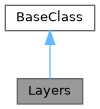
Inheritance diagram for Layers:
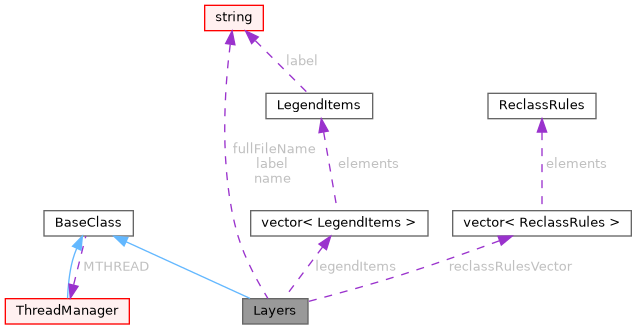
Collaboration diagram for Layers:

Public Member Functions

 Layers (ThreadManager *MTHREAD_h, string name_h, string label_h, bool isInteger_h, bool dynamicContent_h, string fullFilename_h, bool display_h=true)
 In the constructor we set the main layer properties.
 
 ~Layers ()
 
void addLegendItem (int ID_h, string label_h, int rColor_h, int gColor_h, int bColor_h, double minValue_h, double maxValue_h)
 Add a legend item.
 
void addLegendItems (vector< LegendItems > legendItems_h)
 
vector< LegendItemsgetLegendItems ()
 
QColor getColor (double ID_h)
 Evaluates all the legend items to find the one that match the input code, and return its color as a QColor.
 
string getCategory (double ID_h)
 Evaluates all the legend items to find the one that match the input code, and return its label.
 
double filterExogenousDataset (double code_h)
 Used to reclassify the land use map for "generic" categories.
 
void countMyPixels (bool debug=false)
 Count the pixels going to each legend item and print them if debug==true.
 
void randomShuffle ()
 For some sensitivity analisys, random the values for this layer for not-empty values (only integer layers)
 
bool getIsInteger ()
 Return if the layer is integer or not (If integer on each legend item: minValue==maxValue==ID)
 
void print ()
 Print the layer content as an ASCII grid map with its companion files (classification and colors). It always print the whole region, even when subregion is actived.
 
void printBinMap ()
 Print a binary reppresentation of the data (a standard image, e.g. a .png file). It prints only the subregion if this is active.
 
string getName () const
 
string getFilename ()
 Return the filename of the associated dataset.
 
bool getDynamicContent ()
 Return true if the content may change during simulation period.
 
bool getDisplay ()
 
- Public Member Functions inherited from BaseClass
 BaseClass ()
 
 ~BaseClass ()
 
void msgOut (const int &msgCode_h, const string &msg_h, const bool &refreshGUI_h=true) const
 Overloaded function to print the output log.
 
void msgOut (const int &msgCode_h, const int &msg_h, const bool &refreshGUI_h=true) const
 Overloaded function to print the output log.
 
void msgOut (const int &msgCode_h, const double &msg_h, const bool &refreshGUI_h=true) const
 Overloaded function to print the output log.
 
int s2i (const string &string_h) const
 string to integer conversion
 
double s2d (const string &string_h) const
 string to double conversion
 
double s2d (const string &string_h, const bool &replaceComma) const
 string to double conversion
 
bool s2b (const string &string_h) const
 string to bool conversion
 
string i2s (const int &int_h) const
 integer to string conversion
 
string d2s (const double &double_h) const
 double to string conversion
 
string b2s (const bool &bool_h) const
 bool to string conversion
 
vector< int > s2i (const vector< string > &string_h) const
 string to integer conversion (vector)
 
vector< double > s2d (const vector< string > &string_h, const bool &replaceComma=false) const
 string to double conversion (vector)
 
vector< bool > s2b (const vector< string > &string_h) const
 string to bool conversion (vector)
 
vector< string > i2s (const vector< int > &int_h) const
 integer to string conversion (vector)
 
vector< string > d2s (const vector< double > &double_h) const
 double to string conversion (vector)
 
vector< string > b2s (const vector< bool > &bool_h) const
 bool to string conversion (vector)
 
int getType (const string &type_h) const
 Return a type according to enum TYPE_* from a string (eg: "string" -> TYPE_STRING (2))
 
void refreshGUI () const
 Ping to periodically return the control to the GUI.
 
template<typename T >
string toString (const T &x) const
 
template<typename T >
stringTo (const std::string &s) const
 
int vSum (const vector< int > &vector_h) const
 
double vSum (const vector< double > &vector_h) const
 
int vSum (const vector< vector< int > > &vector_h) const
 
double vSum (const vector< vector< double > > &vector_h) const
 
void tokenize (const string &str, vector< string > &tokens, const string &delimiter=" ") const
 Tokenize a string using a delimiter (default is space)
 
void untokenize (string &str, vector< string > &tokens, const string &delimiter=" ") const
 
template<typename K , typename V >
findMap (const map< K, V > &mymap, const K &key, const int &error_level=MSG_CRITICAL_ERROR, const V &notFoundValue=numeric_limits< V >::min()) const
 Lookup a map for a value. Return the value starting from the key.
 
template<typename K , typename V >
void changeMapValue (map< K, V > &mymap, const K &key, const V &value, const int &error_level=MSG_CRITICAL_ERROR)
 Change the value stored in a map given the key and the new value.
 
template<typename K , typename V >
void incrMapValue (map< K, V > &mymap, const K &key, const V &value, const int &error_level=MSG_CRITICAL_ERROR)
 Increments a value stored in a map of the specified value, given the key.
 
template<typename K , typename V >
void incrOrAddMapValue (map< K, V > &mymap, const K &key, const V &value)
 Increments a value stored in a map of the specified value, given the key.
 
template<typename K , typename V >
void resetMapValues (map< K, V > &mymap, const V &value)
 Reset all values stored in a map to the specified one.
 
template<typename K , typename V >
map< K, V > vectorToMap (const vector< K > &keys, const V &value=0.0)
 Returns a map built using the given vector and the given (scalar) value as keys/values pairs.
 
template<typename T >
vector< T > positionsToContent (const vector< T > &vector_h, const vector< int > &positions)
 Return a vector of content from a vector and a vector of positions (int)
 
template<typename V >
void debugMap (const map< iisskey, V > &mymap)
 Debug a map.
 
template<typename K , typename V >
void debugMap (const map< K, V > &mymap, const K &key)
 
template<typename K >
int getMaxPos (const vector< K > &v)
 Returns the position of the maximum element in the vector (the last one in case of multiple equivalent maxima)
 
template<typename K >
int getMinPos (const vector< K > &v)
 Returns the position of the minimum element in the vector (the first one in case of multiple equivalent minima)
 
template<typename K >
getMax (const vector< K > &v)
 Returns the value of the maximum element in the vector (the last one in case of multiple equivalent maxima)
 
template<typename K >
getMin (const vector< K > &v)
 Returns the value of the minimum element in the vector (the first one in case of multiple equivalent minima)
 
template<typename K >
double getAvg (const vector< K > &v)
 Returns the average of the elements in the vector.
 
template<typename K >
double getSd (const vector< K > &v, bool sample=true)
 
template<typename K >
int getPos (const K &element, const vector< K > &v, const int &msgCode_h=MSG_CRITICAL_ERROR)
 
template<typename K >
bool inVector (const K &element, const vector< K > &v)
 
double normSample (const double &avg, const double &stdev, const double &minval=NULL, const double &maxval=NULL) const
 Sample from a normal distribution with bounds. Slower (double time, but still you see the diff only after milion of loops).
 
template<typename K >
normSample (normal_distribution< K > &d, std::mt19937 &gen, const K &minval=NULL, const K &maxval=NULL) const
 Sample from a normal distribution with bounds. Faster (half time) as the normal_distribution is made only once.
 
template<typename T >
std::string toString (const T &x) const
 

Private Attributes

string name
 ID of the layer (no spaces allowed)
 
string label
 Label of the layer (spaces allowed)
 
bool isInteger
 Type of the layer (true==integer, false==double. If true, on each legend item: minValue==maxValue==ID)
 
bool dynamicContent
 True if the content may change during simulation year.
 
bool display
 Normally true, but some layers used to just keep data shoudn't be normally processed.
 
string fullFileName
 Filename of the associated dataset (map)

 
vector< LegendItemslegendItems
 Vector of legend items.
 
vector< ReclassRulesreclassRulesVector
 Vector of initial reclassification rules.
 

Additional Inherited Members

- Protected Attributes inherited from BaseClass
ThreadManagerMTHREAD
 Pointer to the Thread manager.
 

Detailed Description

Define layer objects at the regional level.

Layer class (setting, legend...)
This class define layer objects, including:

  • a set of layer proprieties (name(ID), label, associated dataset, typology (integer or double)
  • a vector of legend items, associating one color to each value or interval
  • a vector of reclassification rule, when we need to work with a level of depth different of those coming with the dataset
    Author
    Antonello Lobianco anton.nosp@m.ello.nosp@m.@regm.nosp@m.as.o.nosp@m.rg

Definition at line 49 of file Layers.h.

Constructor & Destructor Documentation

◆ Layers()

Layers ( ThreadManager MTHREAD_h,
string  name_h,
string  label_h,
bool  isInteger_h,
bool  dynamicContent_h,
string  fullFilename_h,
bool  display_h = true 
)

In the constructor we set the main layer properties.

Definition at line 32 of file Layers.cpp.

33{
34 MTHREAD=MTHREAD_h;
35 name = name_h;
36 label = label_h;
37 isInteger = isInteger_h;
38 dynamicContent = dynamicContent_h;
39 fullFileName = fullFilename_h;
40 display = display_h;
41}
ThreadManager * MTHREAD
Pointer to the Thread manager.
Definition BaseClass.h:467
string label
Label of the layer (spaces allowed)
Definition Layers.h:99
bool display
Normally true, but some layers used to just keep data shoudn't be normally processed.
Definition Layers.h:102
bool dynamicContent
True if the content may change during simulation year.
Definition Layers.h:101
string name
ID of the layer (no spaces allowed)
Definition Layers.h:98
string fullFileName
Filename of the associated dataset (map)
Definition Layers.h:103
bool isInteger
Type of the layer (true==integer, false==double. If true, on each legend item: minValue==maxValue==ID...
Definition Layers.h:100

◆ ~Layers()

~Layers ( )

Definition at line 43 of file Layers.cpp.

44{
45}

Member Function Documentation

◆ addLegendItem()

void addLegendItem ( int  ID_h,
string  label_h,
int  rColor_h,
int  gColor_h,
int  bColor_h,
double  minValue_h,
double  maxValue_h 
)

Add a legend item.

See also
LegendItems

Definition at line 48 of file Layers.cpp.

48 {
49
50 for (uint i=0;i<legendItems.size();i++){
51 if (legendItems.at(i).ID == ID_h){
52 msgOut(MSG_ERROR, "Trying to add a legend item that already exist on this layer (layer: "+label+" - legend label: "+label_h+")");
53 //cout << "ID: "<<ID_h<<" Label: "<<label_h<<" minValue: "<<minValue_h << " maxValue: "<<maxValue_h<<endl;
54 return;
55 }
56 }
57
58 LegendItems ITEM;
59 ITEM.ID = ID_h;
60 ITEM.label = label_h;
61 ITEM.rColor = rColor_h;
62 ITEM.gColor = gColor_h;
63 ITEM.bColor = bColor_h;
64 ITEM.minValue = minValue_h;
65 ITEM.maxValue = maxValue_h;
66 ITEM.cashedCount=0;
67 legendItems.push_back(ITEM);
68
69}
@ MSG_ERROR
Print an ERROR message, but don't stop the model.
Definition BaseClass.h:61
void msgOut(const int &msgCode_h, const string &msg_h, const bool &refreshGUI_h=true) const
Overloaded function to print the output log.
Definition BaseClass.cpp:50
vector< LegendItems > legendItems
Vector of legend items.
Definition Layers.h:104
Legend items.
Definition Layers.h:115
string label
Definition Layers.h:117
int bColor
Definition Layers.h:120
double maxValue
Definition Layers.h:122
int cashedCount
count the pixels whitin a item range
Definition Layers.h:123
double minValue
Definition Layers.h:121
int gColor
Definition Layers.h:119
int rColor
Definition Layers.h:118
Here is the call graph for this function:

◆ addLegendItems()

void addLegendItems ( vector< LegendItems legendItems_h)

Definition at line 72 of file Layers.cpp.

72 {
73 vector <LegendItems> toAdd;
74 for(uint i=0; i<legendItems_h.size();i++){
75 bool existing = false;
76 for (uint j=0;j<legendItems.size();j++){
77 if(legendItems_h[i].ID == legendItems[j].ID){
78 existing = true;
79 break;
80 }
81 }
82 if(existing){
83 msgOut(MSG_WARNING, "Legend item "+i2s(legendItems_h[i].ID)+" non added on layer "+this->name+" as already existing.");
84 } else {
85 toAdd.push_back(legendItems_h[i]);
86 }
87 }
88 legendItems.insert( legendItems.end(), toAdd.begin(), toAdd.end() );
89}
@ MSG_WARNING
Print a WARNING message.
Definition BaseClass.h:60
string i2s(const int &int_h) const
integer to string conversion

Referenced by Gis::applyForestReclassification().

Here is the call graph for this function:
Here is the caller graph for this function:

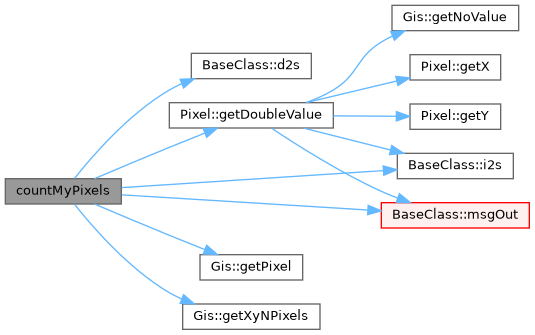
◆ countMyPixels()

void countMyPixels ( bool  debug = false)

Count the pixels going to each legend item and print them if debug==true.

Definition at line 188 of file Layers.cpp.

188 {
189
190 for (uint i=0; i<legendItems.size(); i++){
191 legendItems.at(i).cashedCount=0; //initialized with 0 values...
192 }
193 double totPixels = MTHREAD->GIS->getXyNPixels();
194 double pixelValue;
195 for (uint j=0;j<totPixels;j++){
196 pixelValue = MTHREAD->GIS->getPixel(j)->getDoubleValue(name);
197 if (isInteger){
198 for(uint i=0; i<legendItems.size(); i++){
199 if (legendItems.at(i).ID == ((int)pixelValue)){
200 legendItems.at(i).cashedCount++;
201 break;
202 }
203 }
204 }
205 else {
206 for(uint i=0; i<legendItems.size(); i++){
207 if (pixelValue < legendItems.at(i).maxValue && pixelValue >= legendItems.at(i).minValue){
208 legendItems.at(i).cashedCount++;
209 break;
210 }
211 }
212 }
213 }
214 if (debug){
215 msgOut(MSG_INFO, "Layer statistics - Count by Legend items");
216 msgOut(MSG_INFO, "Layer name: "+label);
217 msgOut(MSG_INFO, "Total plots: "+ d2s(totPixels));
218 for(uint i=0;i<legendItems.size();i++){
219 msgOut(MSG_INFO, legendItems.at(i).label+": "+i2s(legendItems.at(i).cashedCount));
220 }
221 }
222}
@ MSG_INFO
Print an INFO message.
Definition BaseClass.h:59
string d2s(const double &double_h) const
double to string conversion
double getXyNPixels() const
Return the number of pixels on Y.
Definition Gis.h:131
Pixel * getPixel(int x_h, int y_h)
Definition Gis.h:134
double getDoubleValue(const string &layerName_h, const bool &returnZeroForNoValue=false) const
Return the value for a specific layer.
Definition Pixel.cpp:158
Gis * GIS
GIS information and methods.
Here is the call graph for this function:

◆ filterExogenousDataset()

double filterExogenousDataset ( double  code_h)

Used to reclassify the land use map for "generic" categories.

Used in the init stage, this function take as input the real map code as just read from the map file, and filter it according to the reclassification rules.

See also
ReclassRules

Definition at line 97 of file Layers.cpp.

97 {
98 bool check =false;
99 std::vector <double> cumPVector;
100 std::vector <double> outCodesVector;
101 double cumP = 0;
102 double returnCode=0;
103
104 for(uint i=0; i<reclassRulesVector.size(); i++){
105 if (reclassRulesVector.at(i).inCode == code_h){
106 check = true;
107 cumP += reclassRulesVector.at(i).p;
108 cumPVector.push_back(cumP);
109 outCodesVector.push_back(reclassRulesVector.at(i).outCode);
110 }
111 }
112 if (!check) {return code_h;}
113 if (cumP <= 0.99999999 || cumP >= 1.00000001){msgOut(MSG_CRITICAL_ERROR,"the sum of land use reclassification rules is not 1 for at least one input code (input code: "+d2s(code_h)+"; cumP: "+d2s(cumP)+")");}
114 double random;
115 //srand(time(NULL)); // this would re-initialise the random seed
116 random = ((double)rand() / ((double)(RAND_MAX)+(double)(1)) );
117 for(uint i=0; i<cumPVector.size(); i++){
118 if (random <= cumPVector.at(i)){
119 returnCode = outCodesVector.at(i);
120 break;
121 }
122 }
123 return returnCode;
124}
@ MSG_CRITICAL_ERROR
Print an error message and stop the model.
Definition BaseClass.h:62
vector< ReclassRules > reclassRulesVector
Vector of initial reclassification rules.
Definition Layers.h:105
Here is the call graph for this function:

◆ getCategory()

string getCategory ( double  ID_h)

Evaluates all the legend items to find the one that match the input code, and return its label.

This function take as input the value stored in the pixel for the specific layer, loops over the legend item and find the one that match it, returning its label.
If the layer is of type integer, the match is agains legendItem IDs, otherwise we compare the legendItem ranges.

See also
LegendItems

Definition at line 162 of file Layers.cpp.

162 {
163 if (ID_h == MTHREAD->GIS->getNoValue()){
164 return "";
165 }
166 if (isInteger){
167 for(uint i=0; i<legendItems.size(); i++){
168 if (legendItems.at(i).ID == ((int)ID_h)){
169 return legendItems.at(i).label;
170 }
171 }
172 return "";
173 }
174 else {
175 for(uint i=0; i<legendItems.size(); i++){
176 if (ID_h < legendItems.at(i).maxValue && ID_h >= legendItems.at(i).minValue){
177 return legendItems.at(i).label;
178 }
179 }
180 return "";
181 }
182}
double getNoValue() const
Definition Gis.h:133
Here is the call graph for this function:

◆ getColor()

QColor getColor ( double  ID_h)

Evaluates all the legend items to find the one that match the input code, and return its color as a QColor.

This function take as input the value stored in the pixel for the specific layer, loops over the legend item and find the one that match it, returning its color.
If the layer is of type integer, the match is agains legendItem IDs, otherwise we compare the legendItem ranges.

See also
LegendItems

Definition at line 132 of file Layers.cpp.

132 {
133 QColor nocolor(255,255,255);
134 if (ID_h == MTHREAD->GIS->getNoValue()){
135 return nocolor;
136 }
137 if (isInteger){
138 for(uint i=0; i<legendItems.size(); i++){
139 if (legendItems.at(i).ID == ((int)ID_h)){
140 QColor color(legendItems.at(i).rColor, legendItems.at(i).gColor, legendItems.at(i).bColor);
141 return color;
142 }
143 }
144 return nocolor;
145 }
146 else {
147 for(uint i=0; i<legendItems.size(); i++){
148 if (ID_h < legendItems.at(i).maxValue && ID_h >= legendItems.at(i).minValue){
149 QColor color(legendItems.at(i).rColor, legendItems.at(i).gColor, legendItems.at(i).bColor);
150 return color;
151 }
152 }
153 return nocolor;
154 }
155}

Referenced by printBinMap().

Here is the call graph for this function:
Here is the caller graph for this function:

◆ getDisplay()

bool getDisplay ( )
inline

Definition at line 94 of file Layers.h.

94{return display;}

◆ getDynamicContent()

bool getDynamicContent ( )
inline

Return true if the content may change during simulation period.

Definition at line 93 of file Layers.h.

93{return dynamicContent;}

◆ getFilename()

string getFilename ( )
inline

Return the filename of the associated dataset.

Definition at line 91 of file Layers.h.

91{return fullFileName;}

◆ getIsInteger()

bool getIsInteger ( )
inline

Return if the layer is integer or not (If integer on each legend item: minValue==maxValue==ID)

Definition at line 83 of file Layers.h.

83{return isInteger;}

◆ getLegendItems()

vector< LegendItems > getLegendItems ( )
inline

Definition at line 70 of file Layers.h.

70{return legendItems;};

Referenced by Gis::applyForestReclassification().

Here is the caller graph for this function:

◆ getName()

string getName ( ) const
inline

Definition at line 89 of file Layers.h.

89{return name;}

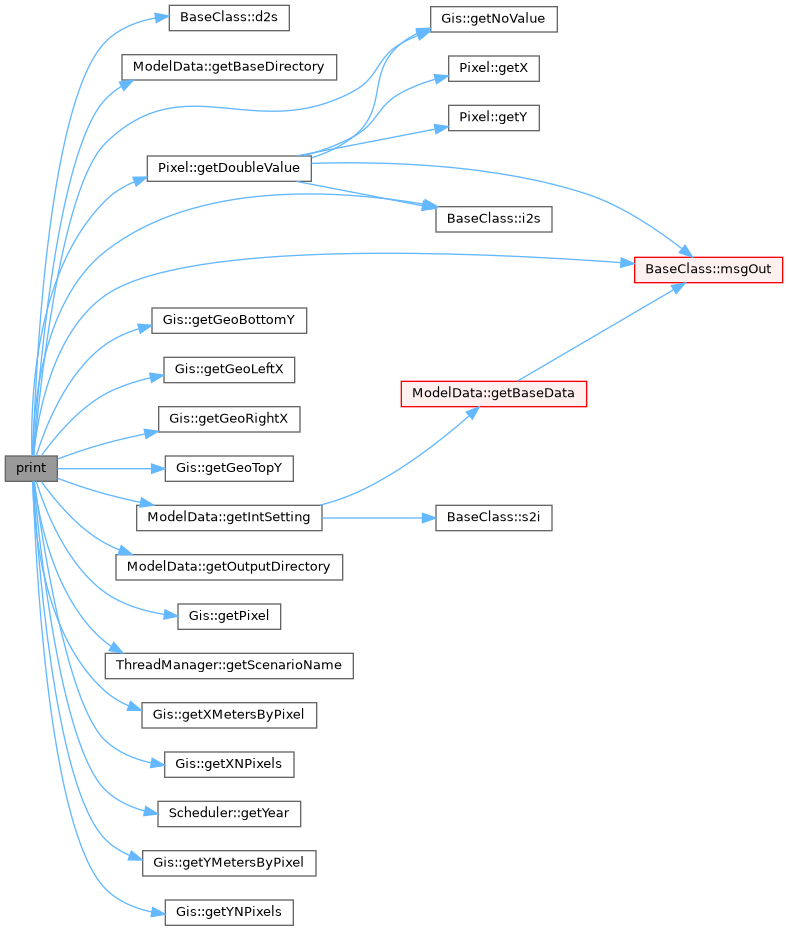
◆ print()

void print ( )

Print the layer content as an ASCII grid map with its companion files (classification and colors). It always print the whole region, even when subregion is actived.

Definition at line 251 of file Layers.cpp.
251 {
252
253 if(MTHREAD->MD->getIntSetting("outputLevel",DATA_NOW)<OUTVL_MAPS) return;
254 //if(!display || !dynamicContent) return; // already checked in Gis::printLayers() and allowed only for the first year
255 string mapBaseDirectory = MTHREAD->MD->getBaseDirectory()+MTHREAD->MD->getOutputDirectory()+"maps/";
256 string mapGridOutputDirectory = mapBaseDirectory+"asciiGrids/";
257 string catsOutputDirectory = mapBaseDirectory+"cats/";
258 string coloursOutputDirectory = mapBaseDirectory+"colr/";
259
260 string mapFilename = mapGridOutputDirectory +name+ "_" +i2s(MTHREAD->SCD->getYear()) +"_" +MTHREAD->getScenarioName();
261 string catsFilename = catsOutputDirectory +name+ "_" +i2s(MTHREAD->SCD->getYear()) +"_" +MTHREAD->getScenarioName();
262 string coloursFilename = coloursOutputDirectory +name+ "_" +i2s(MTHREAD->SCD->getYear()) +"_" +MTHREAD->getScenarioName();
263 string filenameListIntLayers = mapBaseDirectory+"integerListLayers/"+MTHREAD->getScenarioName();
264 string filenameListFloatLayers = mapBaseDirectory+"floatListLayers/"+MTHREAD->getScenarioName();
265
266 // printing the map...
267 string header;
268 if(MTHREAD->MD->getIntSetting("mapOutputFormat",DATA_NOW) == 1){ // GRASS ASCII Grid
269 header = "north: " + d2s(MTHREAD->GIS->getGeoTopY()) + "\n"
270 + "south: " + d2s(MTHREAD->GIS->getGeoBottomY()) + "\n"
271 + "east: " + d2s(MTHREAD->GIS->getGeoRightX()) + "\n"
272 + "west: " + d2s(MTHREAD->GIS->getGeoLeftX()) + "\n"
273 + "rows: " + i2s(MTHREAD->GIS->getYNPixels()) + "\n"
274 + "cols: " + i2s(MTHREAD->GIS->getXNPixels()) + "\n"
275 + "null: " + d2s(MTHREAD->GIS->getNoValue()) + "\n";
276
277 } else if(MTHREAD->MD->getIntSetting("mapOutputFormat",DATA_NOW) == 2){
278 header = "ncols: " + i2s(MTHREAD->GIS->getXNPixels()) + "\n"
279 + "lrows: " + i2s(MTHREAD->GIS->getYNPixels()) + "\n"
280 + "xllcornel: " + d2s(MTHREAD->GIS->getGeoLeftX()) + "\n"
281 + "yllcorner: " + d2s(MTHREAD->GIS->getGeoBottomY()) + "\n"
282 + "cellsize: " + d2s(MTHREAD->GIS->getXMetersByPixel()) + "\n"
283 + "nodata_value: " + d2s(MTHREAD->GIS->getNoValue()) + "\n";
285 msgOut(MSG_ERROR, "The X resolution is different to the Y resolution. I am exporting the map in ArcInfo ASCII Grid format using the X resolution, but be aware that it is incorrect, as this format doesn't support different X-Y resolutions.");
286 }
287
288 } else {
289 msgOut(MSG_ERROR,"Map not print for unknow output type.");
290 }
291
292 ofstream outm; //out map
293 outm.open(mapFilename.c_str(), ios::out); //ios::app to append..
294 if (!outm){ msgOut(MSG_ERROR,"Error in opening the file "+mapFilename+".");}
295 outm << header << "\n";
296
297 for (int i=0;i<MTHREAD->GIS->getYNPixels();i++){
298 for (int j=0;j<MTHREAD->GIS->getXNPixels();j++){
299 outm << MTHREAD->GIS->getPixel(j, i)->getDoubleValue(name) << " ";
300 }
301 outm << "\n";
302 }
303 outm.close();
304
305 //printing the cat file
306 ofstream outc; //out category file
307 outc.open(catsFilename.c_str(), ios::out); //ios::app to append..
308 if (!outc){ msgOut(MSG_ERROR,"Error in opening the file "+catsFilename+".");}
309 outc << "# " << name << "_-_" << i2s(MTHREAD->SCD->getYear()) << "\n\n\n";
310 outc << "0.00 0.00 0.00 0.00"<<"\n";
311
312 if (isInteger){
313 for(uint i=0;i<legendItems.size();i++){
314 outc << legendItems[i].ID << ":"<< legendItems[i].label << "\n";
315 }
316 }
317 else {
318 for(uint i=0;i<legendItems.size();i++){
319 outc << legendItems[i].minValue << ":"<< legendItems[i].maxValue << ":"<< legendItems[i].label << "\n";
320 }
321 }
322
323 //printing the colour legend file
324 ofstream outcl; //out colour file
325 outcl.open(coloursFilename.c_str(), ios::out); //ios::app to append..
326 if (!outcl){ msgOut(MSG_ERROR,"Error in opening the file "+coloursFilename+".");}
327 outcl << "% " << name << "_-_" << i2s(MTHREAD->SCD->getYear()) << "\n\n\n";
328
329 if (isInteger){
330 for(uint i=0;i<legendItems.size();i++){
331 outcl << legendItems[i].ID << ":"<< legendItems[i].rColor << ":" << legendItems[i].gColor << ":" << legendItems[i].bColor << "\n";
332 }
333 }
334 else {
335 for(uint i=0;i<legendItems.size();i++){
336 outcl << legendItems[i].minValue << ":"<< legendItems[i].rColor << ":" << legendItems[i].gColor << ":" << legendItems[i].bColor << " "<< legendItems[i].maxValue << ":"<< legendItems[i].rColor << ":" << legendItems[i].gColor << ":" << legendItems[i].bColor << "\n";
337 }
338 }
339
340 // adding the layer to the list of saved layers..
341 ofstream outList;
342 if (isInteger){
343 outList.open(filenameListIntLayers.c_str(), ios::app); // append !!!
344 outList << name << "_" << MTHREAD->SCD->getYear() << "_" << MTHREAD->getScenarioName() << "\n";
345 }
346 else {
347 outList.open(filenameListFloatLayers.c_str(), ios::app); // append !!!
348 outList << name << "_" << MTHREAD->SCD->getYear() << "_" << MTHREAD->getScenarioName() << "\n";
349 }
350 outList.close();
351}
@ DATA_NOW
The required data is for the current year.
Definition BaseClass.h:73
@ OUTVL_MAPS
Output verbosity level print (also) the maps in ascii grid format.
Definition BaseClass.h:87
double getYMetersByPixel() const
Definition Gis.h:141
int getYNPixels() const
Return the number of pixels on X.
Definition Gis.h:130
double getGeoTopY() const
Return a pixel pointer from its ID.
Definition Gis.h:136
double getGeoLeftX() const
Definition Gis.h:138
int getXNPixels() const
Definition Gis.h:129
double getGeoRightX() const
Definition Gis.h:139
double getXMetersByPixel() const
Definition Gis.h:140
double getGeoBottomY() const
Definition Gis.h:137
string getOutputDirectory() const
Return a vector of objects that together provide the specified resource in the specified quantity.
Definition ModelData.h:113
string getBaseDirectory() const
Definition ModelData.h:118
int getIntSetting(const string &name_h, int position=0, int reg=WORLD) const
int getYear()
Definition Scheduler.h:49
Scheduler * SCD
the scheduler object (simulation-loops scheduler)
string getScenarioName()
ModelData * MD
the model data object
Here is the call graph for this function:

◆ printBinMap()

void printBinMap ( )

Print a binary reppresentation of the data (a standard image, e.g. a .png file). It prints only the subregion if this is active.

Definition at line 354 of file Layers.cpp.
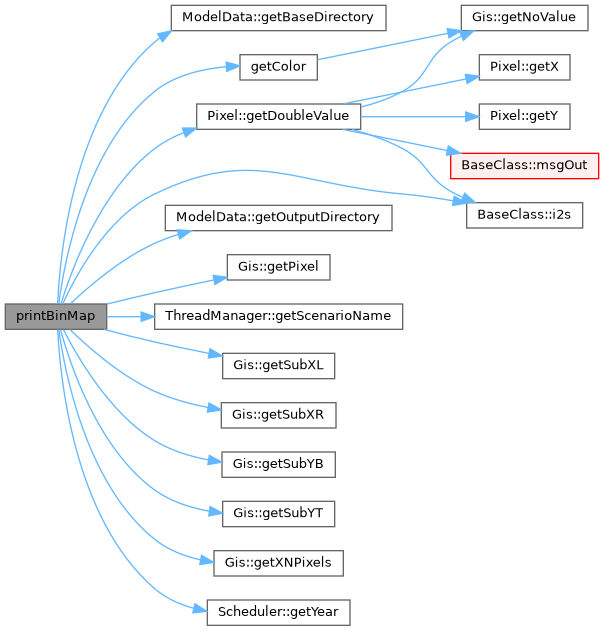
354 {
355
356 if(!display || !dynamicContent) return;
357
358 int xNPixels = MTHREAD->GIS->getXNPixels();
359 int subXR = MTHREAD->GIS->getSubXR();
360 int subXL = MTHREAD->GIS->getSubXL();
361 int subYT = MTHREAD->GIS->getSubYT();
362 int subYB = MTHREAD->GIS->getSubYB();
363
364 string mapBaseDirectory = MTHREAD->MD->getBaseDirectory()+MTHREAD->MD->getOutputDirectory()+"maps/bitmaps/";
365 string mapFilename = mapBaseDirectory +name+ "_" +i2s(MTHREAD->SCD->getYear()) +"_" +MTHREAD->getScenarioName()+".png";
366
367 QImage image = QImage(subXR-subXL+1, subYB-subYT+1, QImage::Format_RGB32);
368 image.fill(qRgb(255, 255, 255));
369 for (int countRow=subYT;countRow<subYB;countRow++){
370 for (int countColumn=subXL;countColumn<subXR;countColumn++){
371 double value = MTHREAD->GIS->getPixel(countRow*xNPixels+countColumn)->getDoubleValue(name);
372 QColor color = this->getColor(value);
373 image.setPixel(countColumn-subXL,countRow-subYT,color.rgb());
374 }
375 }
376 image.save(mapFilename.c_str());
377}
int getSubXR() const
Definition Gis.h:143
int getSubYT() const
Definition Gis.h:144
int getSubXL() const
Definition Gis.h:142
int getSubYB() const
Definition Gis.h:145
QColor getColor(double ID_h)
Evaluates all the legend items to find the one that match the input code, and return its color as a Q...
Definition Layers.cpp:132
Here is the call graph for this function:

◆ randomShuffle()

void randomShuffle ( )

For some sensitivity analisys, random the values for this layer for not-empty values (only integer layers)

Definition at line 224 of file Layers.cpp.
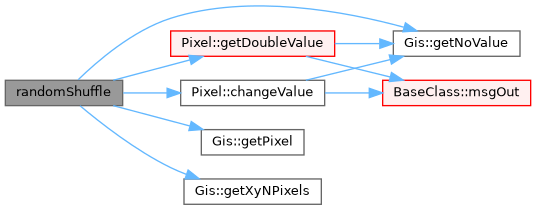
224 {
225
226
227 vector <double> origValues;
228 int maskValue = -MTHREAD->GIS->getNoValue();
229 double totPixels = MTHREAD->GIS->getXyNPixels();
230 for (uint i=0;i<totPixels;i++){
231 double pxValue= MTHREAD->GIS->getPixel(i)->getDoubleValue(name);
232 if(pxValue != MTHREAD->GIS->getNoValue()){
233 origValues.push_back(pxValue);
234 MTHREAD->GIS->getPixel(i)->changeValue(name,maskValue);
235 }
236 }
237 random_shuffle(origValues.begin(), origValues.end()); // randomize the elements of the array.
238
239 for (uint i=0;i<totPixels;i++){
240 double pxValue= MTHREAD->GIS->getPixel(i)->getDoubleValue(name);
241 if(pxValue != MTHREAD->GIS->getNoValue()){
242 double toChangeValue = origValues.at(origValues.size()-1);
243 //cout << toChangeValue << endl;
244 origValues.pop_back();
245 MTHREAD->GIS->getPixel(i)->changeValue(name,toChangeValue);
246 }
247 }
248
249}
void changeValue(const string &layerName_h, const double &value_h, const bool &setNoValueForZero=false)
Change the value of an existing layerMTHREAD->GIS->pack(parName, forName, dClass, year),...
Definition Pixel.cpp:135
Here is the call graph for this function:

Member Data Documentation

◆ display

bool display
private

Normally true, but some layers used to just keep data shoudn't be normally processed.

Definition at line 102 of file Layers.h.

Referenced by getDisplay(), Layers(), and printBinMap().

◆ dynamicContent

bool dynamicContent
private

True if the content may change during simulation year.

Definition at line 101 of file Layers.h.

Referenced by getDynamicContent(), Layers(), and printBinMap().

◆ fullFileName

string fullFileName
private

Filename of the associated dataset (map)

Definition at line 103 of file Layers.h.

Referenced by getFilename(), and Layers().

◆ isInteger

bool isInteger
private

Type of the layer (true==integer, false==double. If true, on each legend item: minValue==maxValue==ID)

Definition at line 100 of file Layers.h.

Referenced by countMyPixels(), getCategory(), getColor(), getIsInteger(), Layers(), and print().

◆ label

string label
private

Label of the layer (spaces allowed)

Definition at line 99 of file Layers.h.

Referenced by addLegendItem(), countMyPixels(), and Layers().

◆ legendItems

vector<LegendItems> legendItems
private

Vector of legend items.

See also
LegendItems

Definition at line 104 of file Layers.h.

Referenced by addLegendItem(), addLegendItems(), countMyPixels(), getCategory(), getColor(), getLegendItems(), and print().

◆ name

string name
private

ID of the layer (no spaces allowed)

Definition at line 98 of file Layers.h.

Referenced by addLegendItems(), countMyPixels(), getName(), Layers(), print(), printBinMap(), and randomShuffle().

◆ reclassRulesVector

vector<ReclassRules> reclassRulesVector
private

Vector of initial reclassification rules.

See also
ReclassRules

Definition at line 105 of file Layers.h.

Referenced by filterExogenousDataset().


The documentation for this class was generated from the following files: