FFSM++ 1.1.0
French Forest Sector Model ++
Loading...
Searching...
No Matches
Gis Class Reference

Class to manage the spatial dimension. More...

#include <Gis.h>
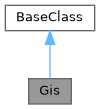
Inheritance diagram for Gis:
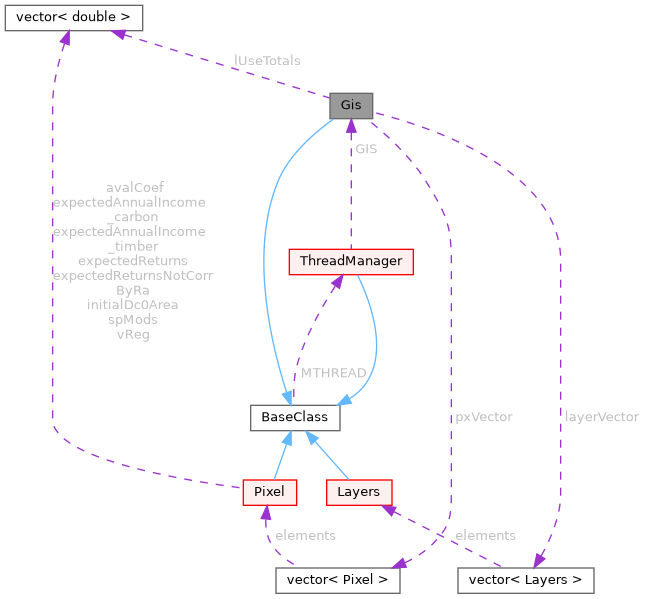
Collaboration diagram for Gis:

Public Member Functions

 Gis (ThreadManager *MTHREAD_h)
 Constructor.
 
 ~Gis ()
 
void setSpace ()
 Set the initial space environment, including loading data from files.
 
void initLayers ()
 Init the layers.
 
void initLayersPixelData ()
 
void initLayersModelData (const int &year_h=DATA_NOW)
 
void applyForestReclassification ()
 Apply the forest reclassification with the rules defined in reclRules sheet.
 
void filterSubRegion (string layerName_h)
 If subregion mode is on, this function place noValues on the selected layer for all out-of-region pixels.
 
void updateImage (string layerName_h)
 Add one layer to the system.
 
void addLayer (string name_h, string label_h, bool isInteger_h, bool dynamicContent_h, string fullFileName_h="", bool display_h=true)
 Fill a layer with empty values.
 
void resetLayer (string layerName_h)
 Check if a layer with a certain name is loaded in the model. Used e.g. to check if the dtm layer (optional) exist.
 
bool layerExist (const string &layerName_h, bool exactMatch=true) const
 Return a pointer to a layer given its name.
 
LayersgetLayer (const string &layerName_h)
 Add a legend item to an existing layer.
 
void addLegendItem (string name_h, int D_h, string label_h, int rColor_h, int gColor_h, int bColor_h, double minValue_h, double maxValue_h)
 
void countItems (const string &layerName_h, const bool &debug=false)
 Count the pixels within each legend item for the selected layer.
 
PixelgetRandomPlotByValue (string layer_h, int layerValue__h)
 Return a pointer to a plot with a specific value for the specified layer.
 
vector< Pixel * > getAllPlotsByValue (string layer_h, int layerValue_h, int outputLevel=MSG_WARNING)
 Return the vector (shuffled) of all plots with a specific value for a specified layer. It is also possible to specify the level in case of failure.
 
vector< Pixel * > getAllPlotsByValue (string layer_h, vector< int > layerValues_h, int outputLevel=MSG_WARNING)
 Return the vector (shuffled) of all plots with specific values for a specified layer. It is also possible to specify the level in case of failure.
 
vector< Pixel * > getAllPlots (bool masked=true, int outputLevel=MSG_WARNING)
 Return the vector (shuffled) of all plots. It is also possible to specify the level in case of failure.
 
vector< Pixel * > getAllPlotsByRegion (ModelRegion &region_h, bool shuffle=false)
 Return the vector of all plots by a specific region (main region or subregion), optionally shuffled;.
 
vector< Pixel * > getAllPlotsByRegion (int regId_h, bool shuffle=false)
 
vector< string > getLayerNames ()
 Return a vector of the layer ids (as string)
 
vector< Layers * > getLayerPointers ()
 Return a vector of pointers of existing layers.
 
void printLayers (string layerName_h="")
 Print the specified layer or all layers (if param layerName_h is missing).
 
void printBinMaps (string layerName_h="")
 Save an image in standard png format.
 
void printDebugValues (string layerName_h, int min_h=0, int max_h=0)
 
double getDistance (const Pixel *px1, const Pixel *px2)
 
int getXNPixels () const
 
int getYNPixels () const
 Return the number of pixels on X.
 
double getXyNPixels () const
 Return the number of pixels on Y.
 
double getHaByPixel () const
 Return the total number of pixels.
 
double getNoValue () const
 
PixelgetPixel (int x_h, int y_h)
 
PixelgetPixel (int ID_h)
 Return a pixel pointer from its coordinates.
 
double getGeoTopY () const
 Return a pixel pointer from its ID.
 
double getGeoBottomY () const
 
double getGeoLeftX () const
 
double getGeoRightX () const
 
double getXMetersByPixel () const
 
double getYMetersByPixel () const
 
int getSubXL () const
 
int getSubXR () const
 
int getSubYT () const
 
int getSubYB () const
 
int sub2realID (int id_h)
 Transform the ID of a pixel in subregion coordinates to the real (and model used) coordinates.
 
string pack (const string &parName, const string &forName, const string &dClass, const int &year) const
 
void unpack (const string &key, string &parName, string &forName, string &dClass, int &year) const
 
void swap (const int &swap_what)
 
- Public Member Functions inherited from BaseClass
 BaseClass ()
 
 ~BaseClass ()
 
void msgOut (const int &msgCode_h, const string &msg_h, const bool &refreshGUI_h=true) const
 Overloaded function to print the output log.
 
void msgOut (const int &msgCode_h, const int &msg_h, const bool &refreshGUI_h=true) const
 Overloaded function to print the output log.
 
void msgOut (const int &msgCode_h, const double &msg_h, const bool &refreshGUI_h=true) const
 Overloaded function to print the output log.
 
int s2i (const string &string_h) const
 string to integer conversion
 
double s2d (const string &string_h) const
 string to double conversion
 
double s2d (const string &string_h, const bool &replaceComma) const
 string to double conversion
 
bool s2b (const string &string_h) const
 string to bool conversion
 
string i2s (const int &int_h) const
 integer to string conversion
 
string d2s (const double &double_h) const
 double to string conversion
 
string b2s (const bool &bool_h) const
 bool to string conversion
 
vector< int > s2i (const vector< string > &string_h) const
 string to integer conversion (vector)
 
vector< double > s2d (const vector< string > &string_h, const bool &replaceComma=false) const
 string to double conversion (vector)
 
vector< bool > s2b (const vector< string > &string_h) const
 string to bool conversion (vector)
 
vector< string > i2s (const vector< int > &int_h) const
 integer to string conversion (vector)
 
vector< string > d2s (const vector< double > &double_h) const
 double to string conversion (vector)
 
vector< string > b2s (const vector< bool > &bool_h) const
 bool to string conversion (vector)
 
int getType (const string &type_h) const
 Return a type according to enum TYPE_* from a string (eg: "string" -> TYPE_STRING (2))
 
void refreshGUI () const
 Ping to periodically return the control to the GUI.
 
template<typename T >
string toString (const T &x) const
 
template<typename T >
stringTo (const std::string &s) const
 
int vSum (const vector< int > &vector_h) const
 
double vSum (const vector< double > &vector_h) const
 
int vSum (const vector< vector< int > > &vector_h) const
 
double vSum (const vector< vector< double > > &vector_h) const
 
void tokenize (const string &str, vector< string > &tokens, const string &delimiter=" ") const
 Tokenize a string using a delimiter (default is space)
 
void untokenize (string &str, vector< string > &tokens, const string &delimiter=" ") const
 
template<typename K , typename V >
findMap (const map< K, V > &mymap, const K &key, const int &error_level=MSG_CRITICAL_ERROR, const V &notFoundValue=numeric_limits< V >::min()) const
 Lookup a map for a value. Return the value starting from the key.
 
template<typename K , typename V >
void changeMapValue (map< K, V > &mymap, const K &key, const V &value, const int &error_level=MSG_CRITICAL_ERROR)
 Change the value stored in a map given the key and the new value.
 
template<typename K , typename V >
void incrMapValue (map< K, V > &mymap, const K &key, const V &value, const int &error_level=MSG_CRITICAL_ERROR)
 Increments a value stored in a map of the specified value, given the key.
 
template<typename K , typename V >
void incrOrAddMapValue (map< K, V > &mymap, const K &key, const V &value)
 Increments a value stored in a map of the specified value, given the key.
 
template<typename K , typename V >
void resetMapValues (map< K, V > &mymap, const V &value)
 Reset all values stored in a map to the specified one.
 
template<typename K , typename V >
map< K, V > vectorToMap (const vector< K > &keys, const V &value=0.0)
 Returns a map built using the given vector and the given (scalar) value as keys/values pairs.
 
template<typename T >
vector< T > positionsToContent (const vector< T > &vector_h, const vector< int > &positions)
 Return a vector of content from a vector and a vector of positions (int)
 
template<typename V >
void debugMap (const map< iisskey, V > &mymap)
 Debug a map.
 
template<typename K , typename V >
void debugMap (const map< K, V > &mymap, const K &key)
 
template<typename K >
int getMaxPos (const vector< K > &v)
 Returns the position of the maximum element in the vector (the last one in case of multiple equivalent maxima)
 
template<typename K >
int getMinPos (const vector< K > &v)
 Returns the position of the minimum element in the vector (the first one in case of multiple equivalent minima)
 
template<typename K >
getMax (const vector< K > &v)
 Returns the value of the maximum element in the vector (the last one in case of multiple equivalent maxima)
 
template<typename K >
getMin (const vector< K > &v)
 Returns the value of the minimum element in the vector (the first one in case of multiple equivalent minima)
 
template<typename K >
double getAvg (const vector< K > &v)
 Returns the average of the elements in the vector.
 
template<typename K >
double getSd (const vector< K > &v, bool sample=true)
 
template<typename K >
int getPos (const K &element, const vector< K > &v, const int &msgCode_h=MSG_CRITICAL_ERROR)
 
template<typename K >
bool inVector (const K &element, const vector< K > &v)
 
double normSample (const double &avg, const double &stdev, const double &minval=NULL, const double &maxval=NULL) const
 Sample from a normal distribution with bounds. Slower (double time, but still you see the diff only after milion of loops).
 
template<typename K >
normSample (normal_distribution< K > &d, std::mt19937 &gen, const K &minval=NULL, const K &maxval=NULL) const
 Sample from a normal distribution with bounds. Faster (half time) as the normal_distribution is made only once.
 
template<typename T >
std::string toString (const T &x) const
 

Private Member Functions

void loadLayersDataFromFile ()
 Load the data of a layer its datafile.
 
void applySpatialStochasticValues ()
 Apply stochastic simulation, e.g. regional volume growth s.d. -> tp multipliers.
 
void applyStochasticRiskAdversion ()
 Give to each agend a stochastic risk adversion. For now Pixel = Agent.
 

Private Attributes

vector< PixelpxVector
 array of Pixel objects
 
vector< LayerslayerVector
 array of Layer objects

 
vector< double > lUseTotals
 totals, in ha, of area in the region for each type (cached values)
 
int xNPixels
 number of pixels along the X dimension
 
int yNPixels
 number of pixels along the Y dimension
 
double xyNPixels
 total number of pixels
 
double xMetersByPixel
 pixel dimension (meters), X
 
double yMetersByPixel
 pixel dimension (meters), Y
 
double geoLeftX
 geo-coordinates of the map left border
 
double geoTopY
 geo-coordinates of the map upper border
 
double geoRightX
 geo-coordinates of the map right border
 
double geoBottomY
 geo-coordinates of the map bottom border
 
double noValue
 value internally use as novalue (individual layer maps can have other values)
 
int subXL
 sub region left X
 
int subXR
 sub region right X
 
int subYT
 sub region top Y
 
int subYB
 sub region bottom Y
 

Additional Inherited Members

- Protected Attributes inherited from BaseClass
ThreadManagerMTHREAD
 Pointer to the Thread manager.
 

Detailed Description

Class to manage the spatial dimension.

Gis class is responsable to provide all methods for spatial analysis.
It is equipped with two important vectors:

  • pxVector contains the array of all pixels on the screen
  • layerVector contains the layer objects
    Along the model, IDs of pixels are assigned from left to right, from top to down:
    —>
    /
    —>
    /
    —>

Pixel origin (0,0) on the top left corner is also the system used by the underlying libraries, but put attencion that instead geographical coordinates, if we are on the North emisfere, are increasing along the up-right direction.

Author
Antonello Lobianco

Definition at line 67 of file Gis.h.

Constructor & Destructor Documentation

◆ Gis()

Gis ( ThreadManager MTHREAD_h)

Constructor.

The constructor of the GIS (unique) instance want:

Parameters
RD_hPointer to the manager of the regional data
MTHREAD_hPointer to the main thread manager

Definition at line 40 of file Gis.cpp.

40 {
41 MTHREAD=MTHREAD_h;
42}
ThreadManager * MTHREAD
Pointer to the Thread manager.
Definition BaseClass.h:467

◆ ~Gis()

~Gis ( )

Definition at line 44 of file Gis.cpp.

44 {
45}

Member Function Documentation

◆ addLayer()

void addLayer ( string  name_h,
string  label_h,
bool  isInteger_h,
bool  dynamicContent_h,
string  fullFileName_h = "",
bool  display_h = true 
)

Fill a layer with empty values.

Called at init time from initLayers, or during model run-time, this function will add a layer to the system.

Parameters
name_hID of the layer (no spaces!)
label_hlayer label
type_htype of the layer, integer or contiguous
dynamicContent_hif it change during the time (so it needs to be printed each year) or not
fullFilename_hif the layer has to be read at the beginning, the name of the associated datafile (default="")

It:

  • had the layer to the layerVector
  • set all pixels with nodata for that specific layer
  • let the GUI know we have a new layer

Definition at line 515 of file Gis.cpp.

515 {
516 if(name_h == "forArea_ash"){
517 bool debug = true;
518 }
519 for(uint i=0; i<layerVector.size(); i++){
520 if (layerVector.at(i).getName() == name_h){
521 msgOut(MSG_ERROR, "Layer already exist with that name");
522 return;
523 }
524 }
525 Layers LAYER (MTHREAD, name_h, label_h, isInteger_h, dynamicContent_h, fullFileName_h, display_h);
526 layerVector.push_back(LAYER);
527
528 for (uint i=0;i<xyNPixels; i++){
529 pxVector[i].setValue(name_h,noValue);
530 }
531 if(display_h){
532 MTHREAD->addLayer(name_h,label_h);
533 }
534
535}
@ MSG_ERROR
Print an ERROR message, but don't stop the model.
Definition BaseClass.h:61
void msgOut(const int &msgCode_h, const string &msg_h, const bool &refreshGUI_h=true) const
Overloaded function to print the output log.
Definition BaseClass.cpp:50
double noValue
value internally use as novalue (individual layer maps can have other values)
Definition Gis.h:170
double xyNPixels
total number of pixels
Definition Gis.h:163
vector< Layers > layerVector
array of Layer objects
Definition Gis.h:159
vector< Pixel > pxVector
array of Pixel objects
Definition Gis.h:158
Define layer objects at the regional level.
Definition Layers.h:49
void addLayer(string layerName_h, string layerLabel_h)

Referenced by applyForestReclassification(), initLayers(), and initLayersPixelData().

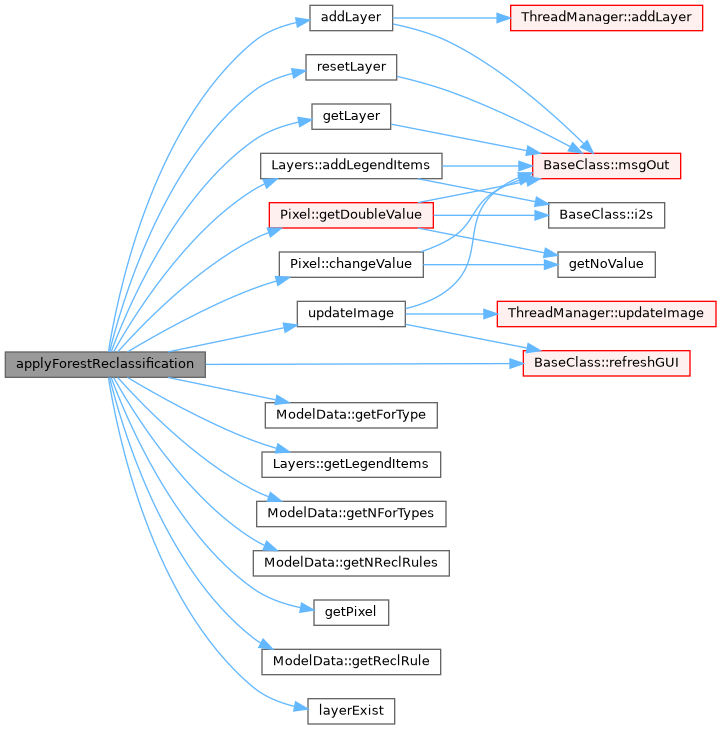
Here is the call graph for this function:
Here is the caller graph for this function:

◆ addLegendItem()

void addLegendItem ( string  name_h,
int  ID_h,
string  label_h,
int  rColor_h,
int  gColor_h,
int  bColor_h,
double  minValue_h,
double  maxValue_h 
)

Search within the layerVector and call addLegendItem(...) to the appropriate one.

Called at init time from initLayers, or during model run-time.

Parameters
name_hName of the layer
ID_hID of the specific lagend item
See also
Layers::addLegendItem

Definition at line 579 of file Gis.cpp.

579 {
580
581 for(uint i=0; i<layerVector.size(); i++){
582 if (layerVector.at(i).getName() == name_h){
583 layerVector.at(i).addLegendItem(ID_h, label_h, rColor_h, gColor_h, bColor_h, minValue_h, maxValue_h);
584 return;
585 }
586 }
587 msgOut(MSG_ERROR, "Trying to add a legend item to a layer that doesn't exist.");
588 return;
589}

Referenced by initLayers().

Here is the call graph for this function:
Here is the caller graph for this function:

◆ applyForestReclassification()

void applyForestReclassification ( )

Apply the forest reclassification with the rules defined in reclRules sheet.

Definition at line 439 of file Gis.cpp.

439 {
440/*per ogni forest type:
441 - crea i layers delle forest type nuovi
442 - riempi con zero
443 - passa le info dal layerr ereditato al nuovo
444 per ogni pixel
445 */
446
447 // caching
448 int nReclassRules = MTHREAD->MD->getNReclRules();
449 vector <reclRule*> RRs;
450 for(uint z=0;z<nReclassRules;z++){
451 RRs.push_back(MTHREAD->MD->getReclRule(z));
452 }
453
454
455
456 for (uint i=0;i< MTHREAD->MD->getNForTypes();i++){
457 forType* FT = MTHREAD->MD->getForType(i);
458 if(!layerExist(FT->forLayer)){
459 addLayer(FT->forLayer, "Are layer for forest type "+FT->forTypeId, false, true);
460 resetLayer(FT->forLayer);
461 Layers* newLayer = getLayer(FT->forLayer);
462 Layers* ereditatedLayer = getLayer(MTHREAD->MD->getForType(FT->ereditatedFrom)->forLayer);
463 newLayer->addLegendItems(ereditatedLayer->getLegendItems());
464 }
465 }
466
467
468 for (uint i=0;i< MTHREAD->MD->getNForTypes();i++){
469 forType* FT = MTHREAD->MD->getForType(i);
470 for(uint j=0;j<xyNPixels;j++){
471 Pixel* PX = getPixel(j);
472 //int regL1 = PX->getDoubleValue ("regLev_1");
473 int regL2 = PX->getDoubleValue ("regLev_2");
474 double value = PX->getDoubleValue (FT->forLayer, true);
475 for(uint z=0;z<nReclassRules;z++){
476 reclRule* RR = RRs[z];
477 //if( (RR->regId == regL2 || RR->regId == regL1) && RR->forTypeOut == FT->forTypeId ){ // we found a reclassification rule for the region where is located this pixel and that output on the for type we are using
478 if( RR->regId == regL2 && RR->forTypeOut == FT->forTypeId ){ // we found a reclassification rule for the region where is located this pixel and that output on the for type we are using
479 string debugForTypeIn = RR->forTypeIn;
480 double inputValue = PX->getDoubleValue(MTHREAD->MD->getForType(RR->forTypeIn)->forLayer, true);
481 double reclassCoeff = RR->coeff;
482 value += inputValue * reclassCoeff ;
483 // not breaking because we may have more than one input for the same output
484 }
485 }
486 PX->changeValue(FT->forLayer, value, true);
487 }
489 }
490 //countItems("forType_B_HF", true);
491 refreshGUI();
492 /*Pixel* DP = getPixel(8386);
493 msgOut(MSG_DEBUG,"Debug info on plot 8386");
494 for (uint i=0;i< MTHREAD->MD->getNForTypes();i++){
495 forType* FT = MTHREAD->MD->getForType(i);
496 msgOut(MSG_DEBUG,FT->forTypeId+" - "+d2s(DP->getDoubleValue (FT->forLayer)));
497 }
498 */
499}
void refreshGUI() const
Ping to periodically return the control to the GUI.
void addLayer(string name_h, string label_h, bool isInteger_h, bool dynamicContent_h, string fullFileName_h="", bool display_h=true)
Fill a layer with empty values.
Definition Gis.cpp:515
Pixel * getPixel(int x_h, int y_h)
Definition Gis.h:134
void resetLayer(string layerName_h)
Check if a layer with a certain name is loaded in the model. Used e.g. to check if the dtm layer (opt...
Definition Gis.cpp:538
Layers * getLayer(const string &layerName_h)
Add a legend item to an existing layer.
Definition Gis.cpp:429
bool layerExist(const string &layerName_h, bool exactMatch=true) const
Return a pointer to a layer given its name.
Definition Gis.cpp:552
void updateImage(string layerName_h)
Add one layer to the system.
Definition Gis.cpp:700
vector< LegendItems > getLegendItems()
Definition Layers.h:70
void addLegendItems(vector< LegendItems > legendItems_h)
Definition Layers.cpp:72
forType * getForType(int position)
Definition ModelData.h:128
int getNForTypes()
Definition ModelData.h:126
int getNReclRules()
Definition ModelData.h:127
reclRule * getReclRule(int position)
Definition ModelData.h:137
Pixel-level class.
Definition Pixel.h:47
void changeValue(const string &layerName_h, const double &value_h, const bool &setNoValueForZero=false)
Change the value of an existing layerMTHREAD->GIS->pack(parName, forName, dClass, year),...
Definition Pixel.cpp:135
double getDoubleValue(const string &layerName_h, const bool &returnZeroForNoValue=false) const
Return the value for a specific layer.
Definition Pixel.cpp:158
ModelData * MD
the model data object
Forest types (struct)
Definition ModelData.h:293
string forTypeId
Definition ModelData.h:294
string forLayer
Definition ModelData.h:297
string ereditatedFrom
Definition ModelData.h:298
IO production matrix between the forest resources and the primary products (struct)
Definition ModelData.h:306
string forTypeOut
Definition ModelData.h:309
int regId
Definition ModelData.h:307
string forTypeIn
Definition ModelData.h:308
double coeff
Definition ModelData.h:310

Referenced by Init::setInitLevel1().

Here is the call graph for this function:
Here is the caller graph for this function:

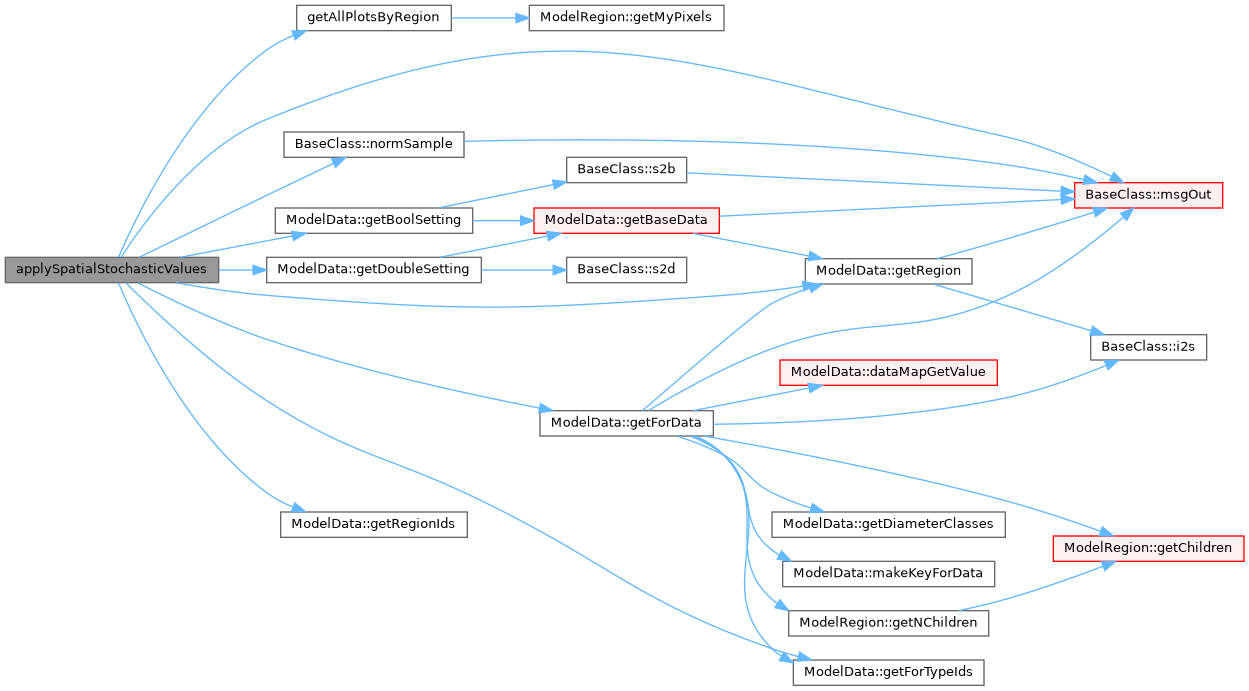
◆ applySpatialStochasticValues()

void applySpatialStochasticValues ( )
private

Apply stochastic simulation, e.g. regional volume growth s.d. -> tp multipliers.

Apply all stochastic modifications required by the model at init time. Currently used to change time of passage devending on regional variance

with simmetric boundary on the cv I do not change the average, but of course I slighly reduce the stdev. See file monte_carlo_with_multipliers_sample_proof.ods

Definition at line 121 of file Gis.cpp.

121 {
122 // apply regional volume growth st.dev. -> variance to pixel based t.p.
123 // - cashing value to the pixels
124 // - apply to the tp layers with change values
125
126 if(!MTHREAD->MD->getBoolSetting("usePixelData")) return;
127
128 vector <int> regIds2 = MTHREAD->MD->getRegionIds(2);
129 //ModelRegion* reg = MTHREAD->MD->getRegion(regIds2[i]);
130 //vector<Pixel*> regPixels = region->getMyPixels();
131 //double sumc = 0;
132 //double nc = 0;
133 for(uint i=0;i<regIds2.size();i++){
134 int regId = regIds2[i];
135 ModelRegion* reg = MTHREAD->MD->getRegion(regId );
136 vector <Pixel*> rpx = MTHREAD->GIS->getAllPlotsByRegion(regId );
137 vector <string> fTypes = MTHREAD->MD->getForTypeIds();
138
139 // regional variance
140 if(MTHREAD->MD->getBoolSetting("useSpatialRegionalVariance")){
141 for(uint j=0; j<fTypes.size(); j++){
142 double sStDev = MTHREAD->MD->getForData("sStDev",regId ,fTypes[j],""); // spatial standard deviation
143 double agr = MTHREAD->MD->getForData("agr",regId ,fTypes[j],""); // average growth
144 // BUG solved 20141220 To obtain a population with the same avg and st.dev of the original using moltipliers, I need to use the cv not the st.dev. !
145 // tested with excel
146 normal_distribution<double> d(1,sStDev/agr); // default any how to double
147 for (uint z=0;z<rpx.size();z++){
148 double c = d(*MTHREAD->gen);
149 double c2 = max(0.4,min(1.6,c)); /// with simmetric boundary on the cv I do not change the average, but of course I slighly reduce the stdev. See file monte_carlo_with_multipliers_sample_proof.ods
150 // TO.DO: Convert it to using normSample where instead of a min/max a loop is used to fund smaples that are within the bounds
151 //cout << regIds2[i] << ";" <<sStDev <<";"<< c <<endl
152 //rpx[z]->correctInputMultiplier("tp_multiplier",fTypes[j],c);
153 //cout << sStDev/agr << " " << c2 << endl;
154 rpx[z]->setSpModifier(c2,j);
155 //sumc += c;
156 //nc ++;
157 }
158 }
159 }
160
161 // expectation types
162 double avgExpTypes = MTHREAD->MD->getDoubleSetting("expType",DATA_NOW,regId);
163 double avgExpTypesPrices = MTHREAD->MD->getDoubleSetting("expTypePrices",DATA_NOW,regId);
164 double expTypes_cv = MTHREAD->MD->getDoubleSetting("expType_cv",DATA_NOW,regId);
165 double expTypesPrices_cv = MTHREAD->MD->getDoubleSetting("expTypePrices_cv",DATA_NOW,regId);
166 if((avgExpTypes<0 || avgExpTypes>1) && avgExpTypes != -1){
167 msgOut(MSG_CRITICAL_ERROR, "expType parameter must be between 1 (expectations) and 0 (adaptative) or -1 (fixed).");
168 }
169 if(avgExpTypesPrices<0 || avgExpTypesPrices>1){
170 msgOut(MSG_CRITICAL_ERROR, "vgExpTypesPrices parameter must be between 1 (expectations) and 0 (adaptative).");
171 }
172 //cout << avgExpTypes << " " << expTypes_cv << endl;
173
174 normal_distribution<double> exp_distr(avgExpTypes,expTypes_cv *avgExpTypes); // works only for double, but default any how to double
175 normal_distribution<double> expPrices_distr(avgExpTypesPrices,expTypesPrices_cv *avgExpTypesPrices);
176
177 for (uint z=0;z<rpx.size();z++){
178 if(avgExpTypes == -1){
179 rpx[z]->expType = -1;
180 } else {
181 //double c = exp_distr(*MTHREAD->gen);
182 //double c2 = max(0.0,min(1.0,c)); /// Bounded [0,1]. With simmetric boundary on the cv I do not change the average, but of course I slighly reduce the stdev. See file monte_carlo_with_multipliers_sample_proof.ods
183 double c3 = normSample(exp_distr,*MTHREAD->gen,0.0,1.0);
184 //cout << "Sampled:\t" << c3 << endl;
185 rpx[z]->expType = c3;
186 }
187 double cPrice = normSample(expPrices_distr,*MTHREAD->gen,0.0,1.0);
188 rpx[z]->expTypePrices = cPrice;
189 }
190 }
191}
@ DATA_NOW
The required data is for the current year.
Definition BaseClass.h:73
@ MSG_CRITICAL_ERROR
Print an error message and stop the model.
Definition BaseClass.h:62
double normSample(const double &avg, const double &stdev, const double &minval=NULL, const double &maxval=NULL) const
Sample from a normal distribution with bounds. Slower (double time, but still you see the diff only a...
vector< Pixel * > getAllPlotsByRegion(ModelRegion &region_h, bool shuffle=false)
Return the vector of all plots by a specific region (main region or subregion), optionally shuffled;.
Definition Gis.cpp:855
bool getBoolSetting(const string &name_h, int position=0, int reg=WORLD) const
double getDoubleSetting(const string &name_h, int position=0, int reg=WORLD) const
vector< string > getForTypeIds(bool all=false)
By default it doesn't return forTypes used only as input.
const double getForData(const string &type_h, const int &regId_h, const string &forType_h, const string &freeDim_h, const int &year=DATA_NOW)
vector< int > getRegionIds(int level_h, bool excludeResidual=true)
ModelRegion * getRegion(int regId_h)
Gis * GIS
GIS information and methods.
std::mt19937 * gen
used in the sampling from normal distribution

Referenced by setSpace().

Here is the call graph for this function:
Here is the caller graph for this function:

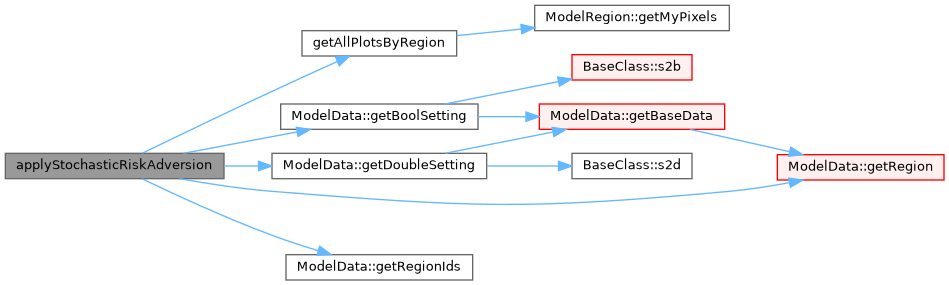
◆ applyStochasticRiskAdversion()

void applyStochasticRiskAdversion ( )
private

Give to each agend a stochastic risk adversion. For now Pixel = Agent.

Apply to each agent a random risk-adversion coefficient

For now, 1 pixel = 1 agent, and avg and st.dev. are the same in the model, but eventually this can change

Definition at line 199 of file Gis.cpp.

199 {
200 // apply regional volume growth st.dev. -> variance to pixel based t.p.
201 // - cashing value to the pixels
202 // - apply to the tp layers with change values
203
204 if(!MTHREAD->MD->getBoolSetting("usePixelData")) return;
205
206 vector <int> regIds2 = MTHREAD->MD->getRegionIds(2);
207 bool raEnabled = MTHREAD->MD->getBoolSetting("heterogeneousRiskAversion");
208 for(uint i=0;i<regIds2.size();i++){
209 int regId = regIds2[i];
210 ModelRegion* reg = MTHREAD->MD->getRegion(regId);
211 vector <Pixel*> rpx = MTHREAD->GIS->getAllPlotsByRegion(regId);
212 for (uint z=0;z<rpx.size();z++){
213 if(raEnabled){
214 double raStDev = MTHREAD->MD->getDoubleSetting("riskAversionAgentSd",DATA_NOW,regId);
215 double avg = MTHREAD->MD->getDoubleSetting("riskAversionAgentAverage",DATA_NOW,regId);
216 normal_distribution<double> d(avg,raStDev); // default any how to double
217 double c = d(*MTHREAD->gen);
218 rpx[z]->setValue ("ra", c);
219 } else {
220 rpx[z]->setValue ("ra", 0.0);
221 }
222 }
223 }
224}

Referenced by setSpace().

Here is the call graph for this function:
Here is the caller graph for this function:

◆ countItems()

void countItems ( const string &  layerName_h,
const bool &  debug = false 
)

Count the pixels within each legend item for the selected layer.

Search within the layerVector and call countMyPixels(...) to the appropriate one.

Called at init time from initLayers, or during model run-time.

Parameters
layerName_hName of the layer
debugPrint the values on the GUI
See also
Layers::countMyPixels

Definition at line 599 of file Gis.cpp.

599 {
600
601 for(uint i=0; i<layerVector.size(); i++){
602 if (layerVector.at(i).getName() == layerName_h){
603 layerVector.at(i).countMyPixels(debug);
604 return;
605 }
606 }
607 msgOut(MSG_ERROR, "Trying to get statistics (count pixels) of a layer that doesn't exist.");
608 return;
609}
Here is the call graph for this function:

◆ filterSubRegion()

void filterSubRegion ( string  layerName_h)

If subregion mode is on, this function place noValues on the selected layer for all out-of-region pixels.

Update the image behind a layer to the GUI;

This function filter the region, placing noValue on the selected informative layer on pixels that are outside the subregion.
It was thinked for speedup the development without have to run the whole model for testing each new implementation, but it can used to see what happen in the model when only a subset of the region is analysed.

Definition at line 921 of file Gis.cpp.

921 {
922 subXL = 0;
923 subYT = 0;
924 subXR = xNPixels-1;
925 subYB = yNPixels-1;
926}
int yNPixels
number of pixels along the Y dimension
Definition Gis.h:162
int subXL
sub region left X
Definition Gis.h:171
int xNPixels
number of pixels along the X dimension
Definition Gis.h:161
int subYT
sub region top Y
Definition Gis.h:173
int subXR
sub region right X
Definition Gis.h:172
int subYB
sub region bottom Y
Definition Gis.h:174

Referenced by loadLayersDataFromFile().

Here is the caller graph for this function:

◆ getAllPlots()

vector< Pixel * > getAllPlots ( bool  masked = true,
int  outputLevel = MSG_WARNING 
)

Return the vector (shuffled) of all plots. It is also possible to specify the level in case of failure.

Parameters
onlyFreePlotsFlag to get only plots marked as free (d=false)
outputLevelLevel of output in case of failure (no plots available). Default is warning, but if set as MSG_CRITICAL_ERROR it make stop the model.

Definition at line 823 of file Gis.cpp.

823 {
824 vector <Pixel* > candidates;
825 if(masked = false){
826 for (uint i=0;i<pxVector.size();i++){
827 candidates.push_back(&pxVector.at(i));
828 }
829 if (candidates.size()>0){
830 random_shuffle(candidates.begin(), candidates.end()); // randomize ther elements of the array... cool !!! ;-)))
831 } else {
832 msgOut(outputLevel,"We can't find any free plot.");
833 }
834 } else {
835 // Only pixels within a L2 region
836 vector <int> regIds2 = MTHREAD->MD->getRegionIds(2);
837 for(uint i=0;i<regIds2.size();i++){
838 vector <Pixel*> rpx = getAllPlotsByRegion(regIds2[i]);
839 //for (uint i=0;i<rpx.size();i++){
840 // candidates.push_back(rpx.at(i));
841 //}
842 candidates.insert( candidates.end(), rpx.begin(), rpx.end() );
843 }
844 if (candidates.size()>0){
845 random_shuffle(candidates.begin(), candidates.end()); // randomize ther elements of the array... cool !!! ;-)))
846 } else {
847 msgOut(outputLevel,"We can't find any free plot.");
848 }
849 }
850 return candidates;
851}

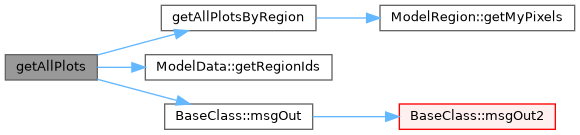
Referenced by initLayersPixelData().

Here is the call graph for this function:
Here is the caller graph for this function:

◆ getAllPlotsByRegion() [1/2]

vector< Pixel * > getAllPlotsByRegion ( int  regId_h,
bool  shuffle = false 
)

Definition at line 864 of file Gis.cpp.

864 {
865 ModelRegion* reg = MTHREAD->MD->getRegion(regId_h);
866 return getAllPlotsByRegion(*reg,shuffle);
867}
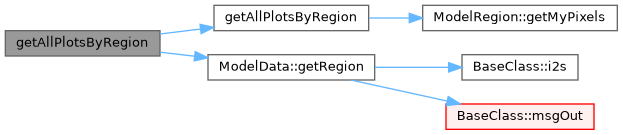
Here is the call graph for this function:

◆ getAllPlotsByRegion() [2/2]

vector< Pixel * > getAllPlotsByRegion ( ModelRegion region_h,
bool  shuffle = false 
)

Return the vector of all plots by a specific region (main region or subregion), optionally shuffled;.

Definition at line 855 of file Gis.cpp.

855 {
856 vector <Pixel*> regionalPixels = region_h.getMyPixels();
857 if(shuffle){
858 random_shuffle(regionalPixels.begin(), regionalPixels.end()); // randomize the elements of the array.
859 }
860 return regionalPixels;
861}
vector< Pixel * > getMyPixels()
Definition ModelRegion.h:86

Referenced by applySpatialStochasticValues(), applyStochasticRiskAdversion(), ModelCoreSpatial::assignSpMultiplierPropToVols(), getAllPlots(), getAllPlotsByRegion(), ModelCoreSpatial::initializePixelArea(), ModelCoreSpatial::initializePixelVolumes(), ModelCore::updateMapAreas(), ModelCoreSpatial::updateMapAreas(), and ModelCoreSpatial::updateOtherMapData().

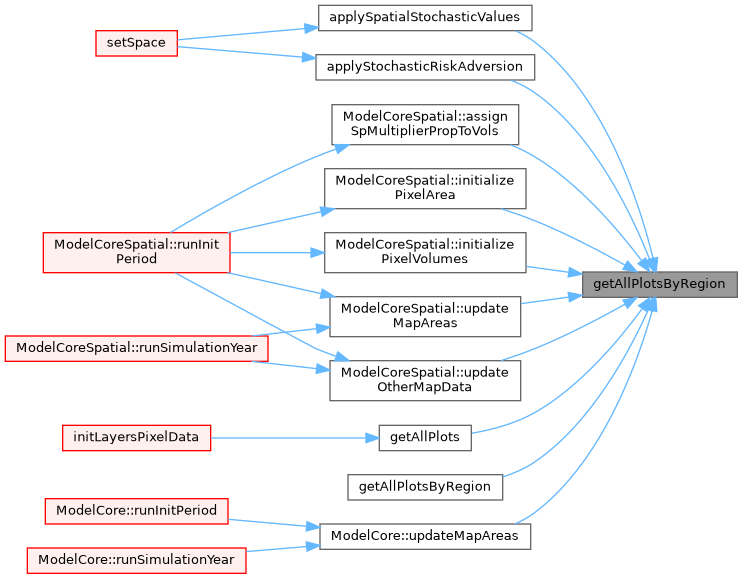
Here is the call graph for this function:
Here is the caller graph for this function:

◆ getAllPlotsByValue() [1/2]

vector< Pixel * > getAllPlotsByValue ( string  layer_h,
int  layerValue_h,
int  outputLevel = MSG_WARNING 
)

Return the vector (shuffled) of all plots with a specific value for a specified layer. It is also possible to specify the level in case of failure.

Parameters
layer_hName of the layer
layerValue_hValue we want the plots for
onlyFreePlotsFlag to get only plots marked as free (d=false)
outputLevelLevel of output in case of failure (no plots available). Default is warning, but if set as MSG_CRITICAL_ERROR it make stop the model.

Definition at line 758 of file Gis.cpp.

758 {
759 // this would be easier to mantain and cleaned code, but slighly slower:
760 //vector<int> layerValues;
761 //layerValues.push_back(layerValue_h);
762 //return getAllPlotsByValue(layer_h, layerValues, onlyFreePlots, outputLevel);
763
764 vector <Pixel* > candidates;
765 for (uint i=0;i<pxVector.size();i++){
766 if(pxVector.at(i).getDoubleValue(layer_h) == layerValue_h){
767 candidates.push_back(&pxVector.at(i));
768 }
769 }
770
771 if (candidates.size()>0){
772 random_shuffle(candidates.begin(), candidates.end()); // randomize ther elements of the array... cool !!! ;-)))
773 }
774 else {
775 msgOut(outputLevel,"We can't find any free pixel with "+d2s(layerValue_h)+" value on layer "+layer_h+".");
776 }
777 return candidates;
778}
string d2s(const double &double_h) const
double to string conversion
Here is the call graph for this function:

◆ getAllPlotsByValue() [2/2]

vector< Pixel * > getAllPlotsByValue ( string  layer_h,
vector< int >  layerValues_h,
int  outputLevel = MSG_WARNING 
)

Return the vector (shuffled) of all plots with specific values for a specified layer. It is also possible to specify the level in case of failure.

Parameters
layer_hName of the layer
layerValues_hValues we want the plots for
onlyFreePlotsFlag to get only plots marked as free (d=false)
outputLevelLevel of output in case of failure (no plots available). Default is warning, but if set as MSG_CRITICAL_ERROR it make stop the model.

Definition at line 790 of file Gis.cpp.
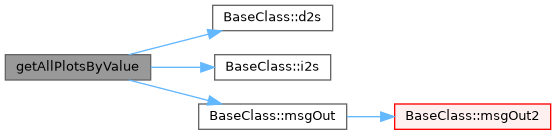
790 {
791 vector <Pixel* > candidates;
792 string valuesToMatch;
793 unsigned int z;
794
795 //string of the required land values to match;
796 for (uint j=0;j<layerValues_h.size();j++){
797 valuesToMatch = valuesToMatch + " " + i2s(layerValues_h.at(j));
798 }
799
800 for (uint i=0;i<pxVector.size();i++){
801 z = valuesToMatch.find(d2s(pxVector.at(i).getDoubleValue(layer_h))); // search if in the string of required values is included also the value of the current plot
802 if(z!=string::npos){ //z is not at the end of the string, means found!
803 candidates.push_back(&pxVector.at(i));
804 }
805 }
806
807 if (candidates.size()>0){
808 random_shuffle(candidates.begin(), candidates.end()); // randomize ther elements of the array... cool !!! ;-)))
809 }
810 else {
811 msgOut(outputLevel,"We can't find any free plot with the specified values ("+valuesToMatch+") on layer "+layer_h+".");
812 }
813 return candidates;
814}
string i2s(const int &int_h) const
integer to string conversion
Here is the call graph for this function:

◆ getDistance()

double getDistance ( const Pixel px1,
const Pixel px2 
)

Definition at line 929 of file Gis.cpp.

929 {
930 return sqrt (
931 pow ( (((double)px1->getX()) - ((double)px2->getX()))*xMetersByPixel,2)
932 +
933 pow ( (((double)px1->getY()) - ((double)px2->getY()))*yMetersByPixel,2)
934 );
935}
double xMetersByPixel
pixel dimension (meters), X
Definition Gis.h:164
double yMetersByPixel
pixel dimension (meters), Y
Definition Gis.h:165
int getX() const
Definition Pixel.h:68
int getY() const
Definition Pixel.h:69
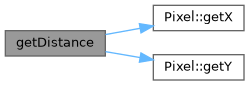
Here is the call graph for this function:

◆ getGeoBottomY()

double getGeoBottomY ( ) const
inline

Definition at line 137 of file Gis.h.

137{return geoBottomY;};
double geoBottomY
geo-coordinates of the map bottom border
Definition Gis.h:169

Referenced by Layers::print().

Here is the caller graph for this function:

◆ getGeoLeftX()

double getGeoLeftX ( ) const
inline

Definition at line 138 of file Gis.h.

138{return geoLeftX;};
double geoLeftX
geo-coordinates of the map left border
Definition Gis.h:166

Referenced by Layers::print().

Here is the caller graph for this function:

◆ getGeoRightX()

double getGeoRightX ( ) const
inline

Definition at line 139 of file Gis.h.

139{return geoRightX;};
double geoRightX
geo-coordinates of the map right border
Definition Gis.h:168

Referenced by Layers::print().

Here is the caller graph for this function:

◆ getGeoTopY()

double getGeoTopY ( ) const
inline

Return a pixel pointer from its ID.

Definition at line 136 of file Gis.h.

136{return geoTopY;};
double geoTopY
geo-coordinates of the map upper border
Definition Gis.h:167

Referenced by Layers::print().

Here is the caller graph for this function:

◆ getHaByPixel()

double getHaByPixel ( ) const
inline

Return the total number of pixels.

Definition at line 132 of file Gis.h.

132{return ((xMetersByPixel*yMetersByPixel)/10000) ;};

Referenced by setSpace().

Here is the caller graph for this function:

◆ getLayer()

Layers * getLayer ( const string &  layerName_h)

Add a legend item to an existing layer.

Init the layers of exogenous data at pixel level (e.g. time of passage) These layers will NOT be read by datafile, but volume for each pixel will be calculated from regional data and area map

Definition at line 429 of file Gis.cpp.

429 {
430 for(uint i=0;i<layerVector.size();i++){
431 if(layerVector[i].getName() == layerName_h){
432 return &layerVector[i];
433 }
434 }
435 msgOut(MSG_CRITICAL_ERROR, "Layer "+layerName_h+" not found. Aborting.");
436}

Referenced by applyForestReclassification().

Here is the call graph for this function:
Here is the caller graph for this function:

◆ getLayerNames()

vector< string > getLayerNames ( )

Return a vector of the layer ids (as string)

Definition at line 872 of file Gis.cpp.

872 {
873 vector <string> toReturn;
874 for (uint i=0;i<layerVector.size();i++){
875 toReturn.push_back(layerVector[i].getName());
876 }
877 return toReturn;
878}

◆ getLayerPointers()

vector< Layers * > getLayerPointers ( )

Return a vector of pointers of existing layers.

Definition at line 881 of file Gis.cpp.

881 {
882 vector <Layers*> toReturn;
883 for (uint i=0;i<layerVector.size();i++){
884 toReturn.push_back(&layerVector[i]);
885 }
886 return toReturn;
887}

Referenced by ThreadManager::computeQuery().

Here is the caller graph for this function:

◆ getNoValue()

double getNoValue ( ) const
inline

Definition at line 133 of file Gis.h.

133{return noValue;};

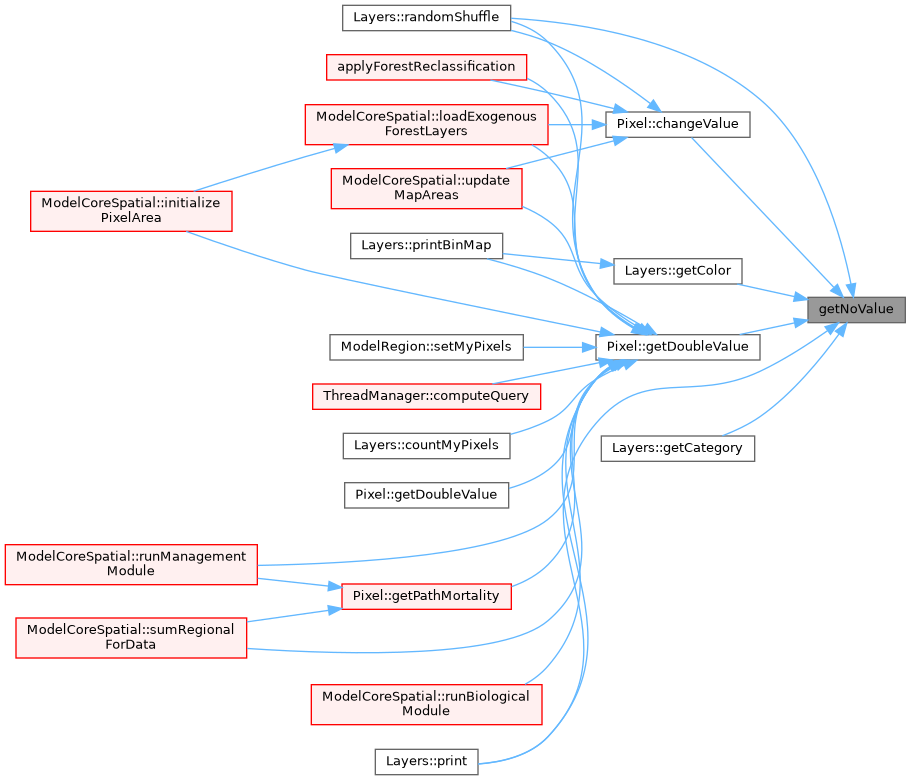
Referenced by Pixel::changeValue(), Layers::getCategory(), Layers::getColor(), Pixel::getDoubleValue(), Layers::print(), and Layers::randomShuffle().

Here is the caller graph for this function:

◆ getPixel() [1/2]

Pixel * getPixel ( int  ID_h)
inline

Return a pixel pointer from its coordinates.

Definition at line 135 of file Gis.h.

135{return &pxVector.at(ID_h);}; ///< Return a pixel pointer from its ID

◆ getPixel() [2/2]

Pixel * getPixel ( int  x_h,
int  y_h 
)
inline

Definition at line 134 of file Gis.h.

134{return &pxVector.at(x_h+y_h*xNPixels);}; ///< Return a pixel pointer from its coordinates

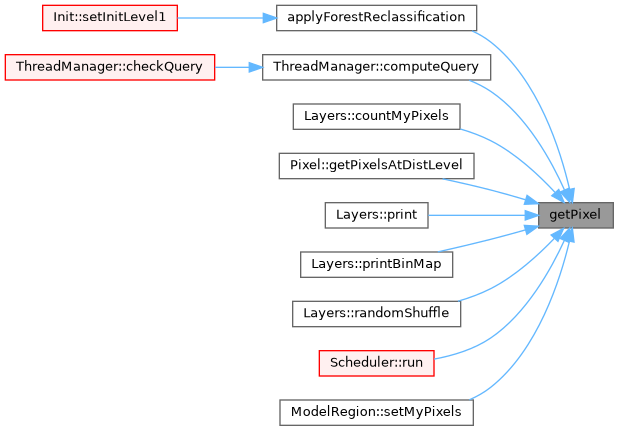
Referenced by applyForestReclassification(), ThreadManager::computeQuery(), Layers::countMyPixels(), Pixel::getPixelsAtDistLevel(), Layers::print(), Layers::printBinMap(), Layers::randomShuffle(), Scheduler::run(), and ModelRegion::setMyPixels().

Here is the caller graph for this function:

◆ getRandomPlotByValue()

Pixel * getRandomPlotByValue ( string  layer_h,
int  layerValue__h 
)

Return a pointer to a plot with a specific value for the specified layer.

Definition at line 730 of file Gis.cpp.

730 {
731
732 vector <Pixel* > candidates;
733 vector <uint> counts;
734 for(uint i=0;i<pxVector.size();i++) counts.push_back(i);
735 random_shuffle(counts.begin(), counts.end()); // randomize the elements of the array.
736
737 for (uint i=0;i<counts.size();i++){
738 if(pxVector.at(counts.at(i)).getDoubleValue(layer_h) == layerValue_h ) {
739 return &pxVector.at(counts.at(i));
740 }
741 }
742
743 msgOut(MSG_CRITICAL_ERROR,"We can't find any plot with "+d2s(layerValue_h)+" value on layer "+layer_h+".");
744 Pixel* toReturn;
745 toReturn =0;
746 return toReturn;
747}
Here is the call graph for this function:

◆ getSubXL()

int getSubXL ( ) const
inline

Definition at line 142 of file Gis.h.

142{return subXL;};

Referenced by Layers::printBinMap().

Here is the caller graph for this function:

◆ getSubXR()

int getSubXR ( ) const
inline

Definition at line 143 of file Gis.h.

143{return subXR;};

Referenced by Layers::printBinMap().

Here is the caller graph for this function:

◆ getSubYB()

int getSubYB ( ) const
inline

Definition at line 145 of file Gis.h.

145{return subYB;};

Referenced by Layers::printBinMap().

Here is the caller graph for this function:

◆ getSubYT()

int getSubYT ( ) const
inline

Definition at line 144 of file Gis.h.

144{return subYT;};

Referenced by Layers::printBinMap().

Here is the caller graph for this function:

◆ getXMetersByPixel()

double getXMetersByPixel ( ) const
inline

Definition at line 140 of file Gis.h.

140{return xMetersByPixel;};

Referenced by Layers::print().

Here is the caller graph for this function:

◆ getXNPixels()

int getXNPixels ( ) const
inline

Definition at line 129 of file Gis.h.

129{return xNPixels;}; ///< Return the number of pixels on X

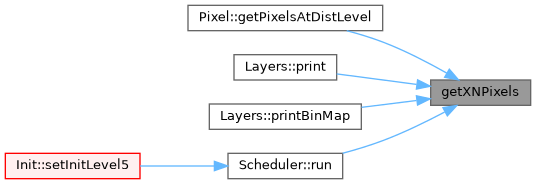
Referenced by Pixel::getPixelsAtDistLevel(), Layers::print(), Layers::printBinMap(), and Scheduler::run().

Here is the caller graph for this function:

◆ getXyNPixels()

double getXyNPixels ( ) const
inline

Return the number of pixels on Y.

Definition at line 131 of file Gis.h.

131{return xyNPixels;}; ///< Return the total number of pixels

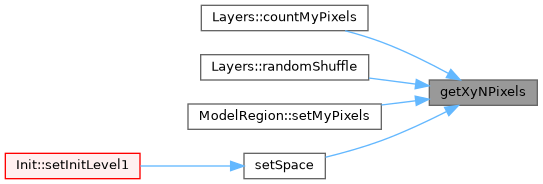
Referenced by Layers::countMyPixels(), Layers::randomShuffle(), ModelRegion::setMyPixels(), and setSpace().

Here is the caller graph for this function:

◆ getYMetersByPixel()

double getYMetersByPixel ( ) const
inline

Definition at line 141 of file Gis.h.

141{return yMetersByPixel;};

Referenced by Layers::print().

Here is the caller graph for this function:

◆ getYNPixels()

int getYNPixels ( ) const
inline

Return the number of pixels on X.

Definition at line 130 of file Gis.h.

130{return yNPixels;}; ///< Return the number of pixels on Y

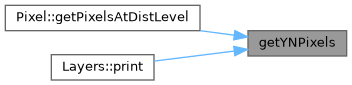
Referenced by Pixel::getPixelsAtDistLevel(), and Layers::print().

Here is the caller graph for this function:

◆ initLayers()

void initLayers ( )

Init the layers.

Called from setSpace(), initLayers() is responsable of:

  • load each layer propriety (name, label, datafile..)
  • add the layer to the system
    See also
    addLayer
    If the layer is to be read at start-up:
  • adding to the layer each legend item (ID, label, min-max values..)
    See also
    addLegendItem
  • [REMOVED, as reclassification rules are in the input ods file now, not in the gis input file] eventually adding to the layer each reclassification rules
    See also
    addReclassificationRule

Definition at line 259 of file Gis.cpp.

259 {
260 // setting layers...
261 //string filename_complete= MTHREAD->MD->getFilenameByType("gis");
262 string filename_complete = MTHREAD->getBaseDirectory()+MTHREAD->MD->getStringSetting("gisFilename");
263
264 InputNode gisDocument;
265 bool test=gisDocument.setWorkingFile(filename_complete);
266 if (!test){msgOut(MSG_CRITICAL_ERROR, "Error opening the gis file "+filename_complete+".");}
267 vector<InputNode> layerNodes = gisDocument.getNodesByName("layer");
268 vector<string> ftIds = MTHREAD->MD->getForTypeIds();
269 for (uint i=0; i<layerNodes.size();i++){
270
271 string nameOrig = layerNodes.at(i).getNodeByName("name").getStringContent();
272 string labelOrig = layerNodes.at(i).getNodeByName("label").getStringContent();
273 bool isInteger = layerNodes.at(i).getNodeByName("isInteger").getBoolContent();
274 bool dynamicContent = layerNodes.at(i).getNodeByName("dynamicContent").getBoolContent();
275 bool expandByFt = layerNodes.at(i).getNodeByName("expandByFt").getBoolContent();
276 string readAtStart = layerNodes.at(i).getNodeByName("readAtStart").getStringContent();
277 if (readAtStart != "true") continue;
278 string dirName = layerNodes.at(i).getNodeByName("dirName").getStringContent();
279 string fileName = layerNodes.at(i).getNodeByName("fileName").getStringContent();
280
281 // Eventually expanding this input layern in as many layer as forest types exists..
282 uint endingLoop = expandByFt ? ftIds.size(): 1;
283 for(uint z=0;z<endingLoop;z++){
284 string ftExtension= expandByFt ? "_"+ftIds[z]:"";
285 string labelFtExtension= expandByFt ? " ("+ftIds[z]+")":"";
286 string name = nameOrig+ftExtension;
287 string label = labelOrig + labelFtExtension;
288
289 string fullFileName = ((dirName == "") || (fileName==""))?"":MTHREAD->MD->getBaseDirectory()+dirName+fileName+ftExtension; // TODO: ugly: one would have to put mmyfile.grd_broadL_highF
290 addLayer(name,label,isInteger,dynamicContent,fullFileName);
291 //legend..
292 vector<InputNode> legendItemsNodes = layerNodes.at(i).getNodesByName("legendItem");
293 for (uint j=0; j<legendItemsNodes.size();j++){
294 int lID = legendItemsNodes.at(j).getIntContent();
295 string llabel = legendItemsNodes.at(j).getStringAttributeByName("label");
296 int rColor = legendItemsNodes.at(j).getIntAttributeByName("rColor");
297 int gColor = legendItemsNodes.at(j).getIntAttributeByName("gColor");
298 int bColor = legendItemsNodes.at(j).getIntAttributeByName("bColor");
299 double minValue, maxValue;
300 if (isInteger){
301 minValue = ((double)lID);
302 maxValue = ((double)lID);
303 }
304 else {
305 minValue = legendItemsNodes.at(j).getDoubleAttributeByName("minValue");
306 maxValue = legendItemsNodes.at(j).getDoubleAttributeByName("maxValue");
307 }
308 addLegendItem(name, lID, llabel, rColor, gColor, bColor, minValue, maxValue);
309 }
310 }
311 }
313 //initLayersModelData(DATA_INIT); // only the layers relative to the initial years are inserted now. All the simulation year layers will be added each year before mainSimulationyear()
314}
void initLayersPixelData()
Definition Gis.cpp:320
void addLegendItem(string name_h, int D_h, string label_h, int rColor_h, int gColor_h, int bColor_h, double minValue_h, double maxValue_h)
Definition Gis.cpp:579
Wrapper around the underlying library for reading DOM elements (nodes).
Definition InputNode.h:51
bool setWorkingFile(std::string filename_h)
Load the file on memory. Return false if no success.
Definition InputNode.cpp:37
vector< InputNode > getNodesByName(string nodeName_h, int debugLevel=MSG_WARNING, bool childFlag=false)
string getStringSetting(const string &name_h, int position=0, int reg=WORLD) const
string getBaseDirectory()

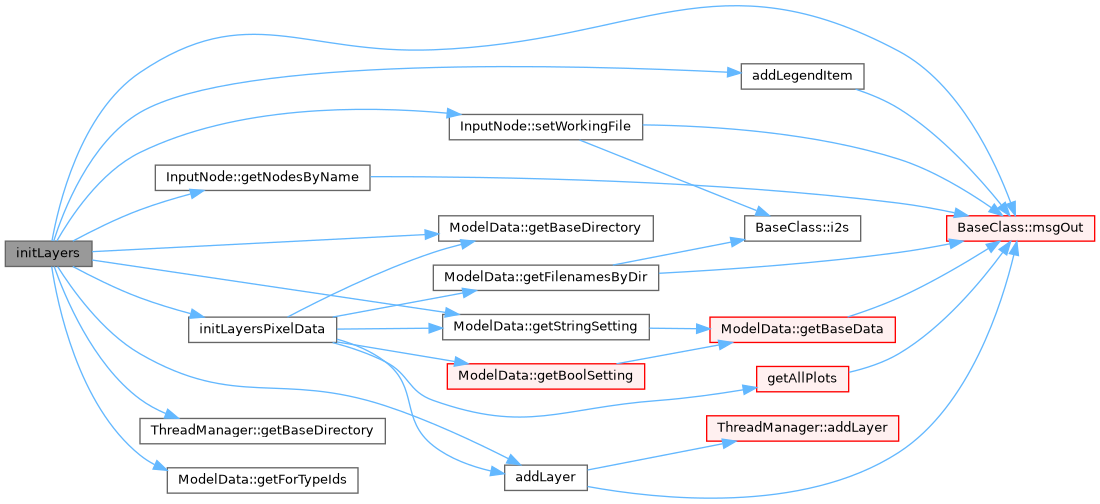
Referenced by setSpace().

Here is the call graph for this function:
Here is the caller graph for this function:

◆ initLayersModelData()

void initLayersModelData ( const int &  year_h = DATA_NOW)

◆ initLayersPixelData()

void initLayersPixelData ( )

Init the layers of exogenous data at pixel level (e.g. time of passage, multipliers, volumes of sp. espl. ft, spread models) These layers will then be read from datafile

See also
loadLayersDataFromFile

Definition at line 320 of file Gis.cpp.

320 {
321 if (!MTHREAD->MD->getBoolSetting("usePixelData")){return;}
322 string dir = MTHREAD->MD->getBaseDirectory()+MTHREAD->MD->getStringSetting("spatialDataSubfolder");
323 string fileExt = MTHREAD->MD->getStringSetting("spatialDataFileExtension");
324 vector<string> files = vector<string>();
325 string fullFilename, filename, fullPath;
326 //string parName, forName, dClass, yearString;
327 //int year;
328
329 MTHREAD->MD->getFilenamesByDir(dir,files, fileExt); // Ugly format. Files is the output (reference)
330
331 for (unsigned int i = 0;i < files.size();i++) {
332 fullFilename = files[i];
333 fullPath = dir+"/"+fullFilename;
334 filename = fullFilename.substr(0,fullFilename.find_last_of("."));
335 addLayer(filename,filename,false,false,fullPath,false);
336 }
337
338 // Loading volumes of forest types that are spatially known..
339 if(MTHREAD->MD->getBoolSetting("useSpExplicitForestTypes")){
340 string dir2 = MTHREAD->MD->getBaseDirectory()+MTHREAD->MD->getStringSetting("spExplicitForTypesInputDir");
341 string fileExt2 = MTHREAD->MD->getStringSetting("spExplicitForTypesFileExtension");
342 vector<string> files2 = vector<string>();
343 string fullFilename2, filename2, fullPath2;
344 MTHREAD->MD->getFilenamesByDir (dir2,files2, fileExt2); // Ugly format. Files is the output (reference)
345 for (unsigned int i = 0;i < files2.size();i++) {
346 fullFilename2 = files2[i];
347 fullPath2 = dir2+"/"+fullFilename2;
348 filename2 = fullFilename2.substr(0,fullFilename2.find_last_of("."));
349 addLayer(filename2,filename2,false,false,fullPath2,false);
350 }
351 }
352
353 // Loading pathogens exogenous spread models...
354 if(MTHREAD->MD->getBoolSetting("usePathogenModule")){
355 string dir2 = MTHREAD->MD->getBaseDirectory()+MTHREAD->MD->getStringSetting("pathogenExogenousSpreadModelFolder");
356 string fileExt2 = MTHREAD->MD->getStringSetting("pathogenExogenousSpreadModelFileExtension");
357 vector<string> files2 = vector<string>();
358 string fullFilename2, filename2, fullPath2;
359 MTHREAD->MD->getFilenamesByDir (dir2,files2, fileExt2); // Ugly format. Files is the output (reference)
360 for (unsigned int i = 0;i < files2.size();i++) {
361 fullFilename2 = files2[i];
362 fullPath2 = dir2+"/"+fullFilename2;
363 filename2 = fullFilename2.substr(0,fullFilename2.find_last_of("."));
364 addLayer(filename2,filename2,false,false,fullPath2,false);
365 }
366 }
367
368 // Add layer of pixel IDs
369 addLayer("pixelIds","Pixel IDs", true, false, "", true);
370 vector <Pixel*> allPx = getAllPlots(false);
371 for (unsigned int i = 0; i < allPx.size();i++) {
372 allPx[i]->changeValue("pixelIds", allPx[i]->getID());
373 }
374
375
376
377}
vector< Pixel * > getAllPlots(bool masked=true, int outputLevel=MSG_WARNING)
Return the vector (shuffled) of all plots. It is also possible to specify the level in case of failur...
Definition Gis.cpp:823
string getBaseDirectory() const
Definition ModelData.h:118
int getFilenamesByDir(const string &dir, vector< string > &files, const string &filter="")
Return a list of files in a directory.

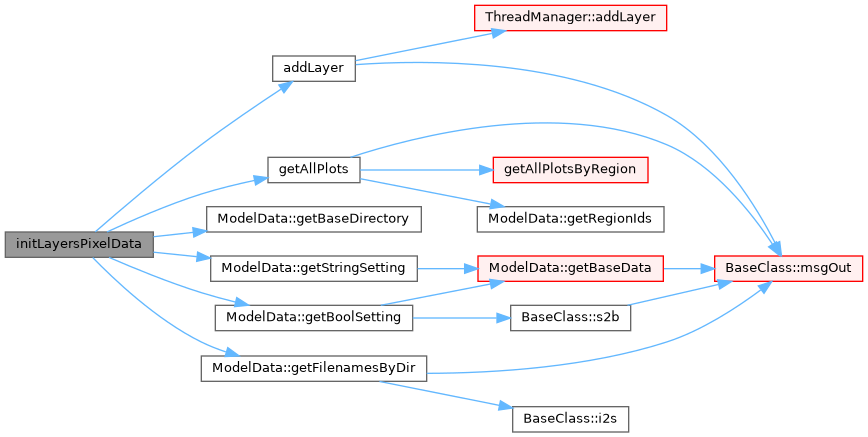
Referenced by initLayers().

Here is the call graph for this function:
Here is the caller graph for this function:

◆ layerExist()

bool layerExist ( const string &  layerName_h,
bool  exactMatch = true 
) const

Return a pointer to a layer given its name.

Definition at line 552 of file Gis.cpp.

552 {
553
554 if(exactMatch){
555 for(uint i=0; i<layerVector.size(); i++){
556 if (layerVector.at(i).getName() == layerName_h){
557 return true;
558 }
559 }
560 } else { // partial matching (stored layer name begin with search parameter)
561 for(uint i=0; i<layerVector.size(); i++){
562 if (layerVector.at(i).getName().compare(0, layerName_h.size(),layerName_h )){
563 return true;
564 }
565 }
566 }
567
568 return false;
569}

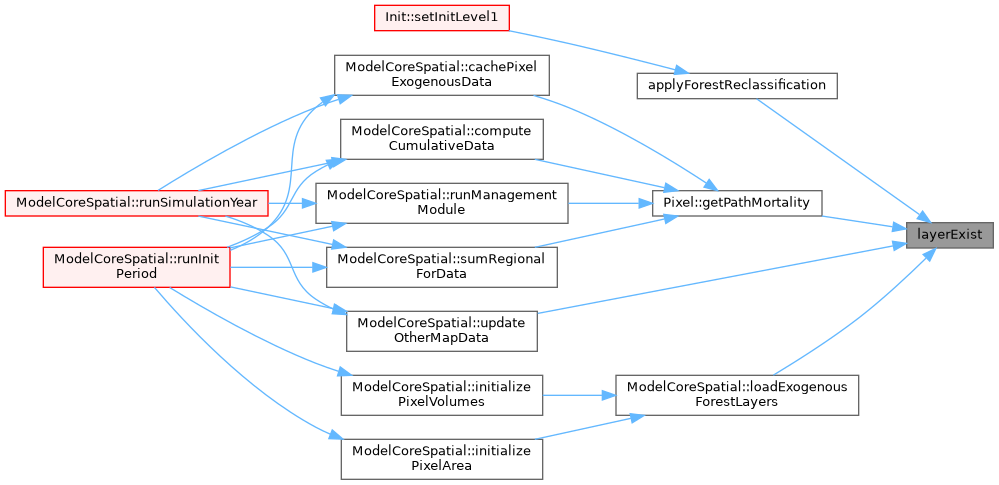
Referenced by applyForestReclassification(), Pixel::getPathMortality(), ModelCoreSpatial::loadExogenousForestLayers(), and ModelCoreSpatial::updateOtherMapData().

Here is the caller graph for this function:

◆ loadLayersDataFromFile()

void loadLayersDataFromFile ( )
private

Load the data of a layer its datafile.

Called at init time from initLayers, this function load the associated datafile to the existing layers (that if exists at this stage are all of type to be loaded at start-up).
This function loop over layerVector and works with GRASS/ASCII (tested) or ARC/ASCII (untested) datasets, assigning to each pixel the readed value to the corresponding layer.
The function also "compose" the initial map with the colors read by the layer (for each specific values) and send the map to the GUI.

NOTE: It uses some Qt functions!!!

See also
Pixel::changeValue
Layers::filterExogenousDataset
Layers::getColor

Definition at line 624 of file Gis.cpp.

624 {
625 double localNoValue = noValue;
626 double inputValue;
627 double outputValue;
628 QColor color;
629
630 for(uint i=0;i<layerVector.size();i++){
631 string layerName =layerVector.at(i).getName();
632 string fileName=layerVector.at(i).getFilename();
633 if(fileName == "") continue; // BUGGED !!! 20121017, Antonello. It was "return", so it wasn't reading any layers following a layer with no filename
634 QFile file(fileName.c_str());
635 if (!file.open(QFile::ReadOnly)) {
636 cerr << "Cannot open file for reading: "
637 << qPrintable(file.errorString()) << endl;
638 msgOut(MSG_ERROR, "Cannot open map file "+fileName+" for reading.");
639 continue;
640 }
641 QTextStream in(&file);
642 int countRow = 0;
643 QImage image = QImage(xNPixels, yNPixels, QImage::Format_RGB32);
644 image.fill(qRgb(255, 255, 255));
645 while (!in.atEnd()) {
646 QString line = in.readLine();
647 QStringList fields = line.split(' ');
648 if (
649 (fields.at(0)== "north:" && fields.at(1).toDouble() != geoTopY)
650 || ((fields.at(0)== "south:" || fields.at(0) == "yllcorner" ) && fields.at(1).toDouble() != geoBottomY)
651 || (fields.at(0)== "east:" && fields.at(1).toDouble() != geoRightX)
652 || ((fields.at(0)== "west:" || fields.at(0) == "xllcorner" ) && fields.at(1).toDouble() != geoLeftX)
653 || ((fields.at(0)== "rows:" || fields.at(0) == "nrows" ) && fields.at(1).toInt() != yNPixels)
654 || ((fields.at(0)== "cols:" || fields.at(0) == "ncols" ) && fields.at(1).toInt() != xNPixels)
655 )
656 {
657 msgOut(MSG_ERROR, "Layer "+layerName+" has different coordinates. Aborting reading.");
658 break;
659 } else if (fields.at(0)== "null:" || fields.at(0) == "NODATA_value" || fields.at(0) == "nodata_value" ) {
660 localNoValue = fields.at(1).toDouble();
661 } else if (fields.size() > 5) {
662 for (int countColumn=0;countColumn<xNPixels;countColumn++){
663 inputValue = fields.at(countColumn).toDouble();
664 if (inputValue == localNoValue){
665 outputValue = noValue;
666 pxVector.at((countRow*xNPixels+countColumn)).changeValue(layerName,outputValue);
667 QColor nocolor(255,255,255);
668 color = nocolor;
669 }
670 else {
671 outputValue=layerVector.at(i).filterExogenousDataset(fields.at(countColumn).toDouble());
672 pxVector.at((countRow*xNPixels+countColumn)).changeValue(layerName,outputValue);
673 color = layerVector.at(i).getColor(outputValue);
674 }
675 image.setPixel(countColumn,countRow,color.rgb());
676 }
677 countRow++;
678 }
679 }
680 if (MTHREAD->MD->getBoolSetting("initialRandomShuffle") ){
681 layerVector.at(i).randomShuffle();
682 }
683 this->filterSubRegion(layerName);
684 if(layerVector.at(i).getDisplay()){
685 MTHREAD->updateImage(layerName,image);
686 //send the image to the gui...
687 refreshGUI();
688 }
689
690
691 }
692}
void filterSubRegion(string layerName_h)
If subregion mode is on, this function place noValues on the selected layer for all out-of-region pix...
Definition Gis.cpp:921
void updateImage(string layerName_h, const QImage &image_h)

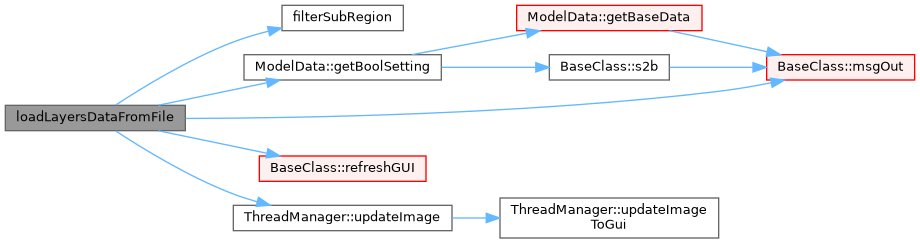
Referenced by setSpace().

Here is the call graph for this function:
Here is the caller graph for this function:

◆ pack()

string pack ( const string &  parName,
const string &  forName,
const string &  dClass,
const int &  year 
) const
inline

Definition at line 148 of file Gis.h.

148{return parName+"#"+forName+"#"+dClass+"#"+i2s(year)+"#";};

Referenced by Pixel::getDoubleValue().

Here is the call graph for this function:
Here is the caller graph for this function:

◆ printBinMaps()

void printBinMaps ( string  layerName_h = "")

Save an image in standard png format.

Print debug information (for each pixel in the requested interval, their values on the specified layer)

Definition at line 963 of file Gis.cpp.

963 {
964 msgOut(MSG_DEBUG,"Printing the maps as images");
965 int iteration = MTHREAD->SCD->getIteration(); // are we on the first year of the simulation ??
966 if(layerName_h == ""){
967 for (uint i=0;i<layerVector.size();i++){
968 if (!iteration || layerVector[i].getDynamicContent()) {layerVector[i].printBinMap();}
969 }
970 } else {
971 for (uint i=0;i<layerVector.size();i++){
972 if(layerVector[i].getName() == layerName_h){
973 if (!iteration || layerVector[i].getDynamicContent()) {layerVector[i].printBinMap();}
974 return;
975 }
976 }
977 msgOut(MSG_ERROR, "Layer "+layerName_h+" unknow. No layer printed.");
978 }
979}
@ MSG_DEBUG
Print a debug message, normally filtered out.
Definition BaseClass.h:58
int getIteration()
Definition Scheduler.h:48
Scheduler * SCD
the scheduler object (simulation-loops scheduler)

Referenced by Output::printMaps().

Here is the call graph for this function:
Here is the caller graph for this function:

◆ printDebugValues()

void printDebugValues ( string  layerName_h,
int  min_h = 0,
int  max_h = 0 
)

Definition at line 890 of file Gis.cpp.

890 {
891 int min=min_h;
892 int max;
893 int ID, X, Y;
894 string out;
895 double value;
896 //double noValue = MTHREAD->MD->getDoubleSetting("noValue");
897 if (max_h==0){
898 max= pxVector.size();
899 }
900 else {
901 max = max_h;
902 }
903 msgOut(MSG_DEBUG,"Printing debug information for layer "+layerName_h+".");
904 for (int i=min;i<max;i++){
905 value = pxVector.at(i).getDoubleValue(layerName_h);
906 if (value != noValue){
907 ID = i;
908 X = pxVector.at(i).getX();
909 Y = pxVector.at(i).getY();
910 out = "Px. "+i2s(ID)+" ("+i2s(X)+","+i2s(Y)+"): "+d2s(value);
911 msgOut(MSG_DEBUG,out);
912 }
913 }
914}
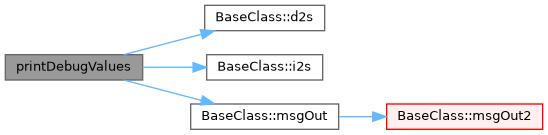
Here is the call graph for this function:

◆ printLayers()

void printLayers ( string  layerName_h = "")

Print the specified layer or all layers (if param layerName_h is missing).

See also
Layers::print()

Definition at line 940 of file Gis.cpp.

940 {
941 msgOut(MSG_DEBUG,"Printing the layers");
942 int iteration = MTHREAD->SCD->getIteration(); // are we on the first year of the simulation ??
943 if(layerName_h == ""){
944 for (uint i=0;i<layerVector.size();i++){
945 //if(layerVector[i].getName() == "pixelIds"){
946 // cout << layerVector[i].getName() << endl;
947 //}
948 // not printing if we are in a not-0 iteration and the content of the map doesn't change
949 if (!iteration || layerVector[i].getDynamicContent()) layerVector[i].print();
950 }
951 } else {
952 for (uint i=0;i<layerVector.size();i++){
953 if(layerVector[i].getName() == layerName_h){
954 if (!iteration || layerVector[i].getDynamicContent()) layerVector[i].print();
955 return;
956 }
957 }
958 msgOut(MSG_ERROR, "Layer "+layerName_h+" unknow. No layer printed.");
959 }
960}

Referenced by Output::printMaps().

Here is the call graph for this function:
Here is the caller graph for this function:

◆ resetLayer()

void resetLayer ( string  layerName_h)

Check if a layer with a certain name is loaded in the model. Used e.g. to check if the dtm layer (optional) exist.

Definition at line 538 of file Gis.cpp.

538 {
539
540 for(uint i=0; i<layerVector.size(); i++){
541 if (layerVector.at(i).getName() == layerName_h){
542 for (uint i=0;i<xyNPixels; i++){
543 pxVector.at(i).changeValue(layerName_h,noValue); // bug solved 20071022, Antonello
544 }
545 return;
546 }
547 }
548 msgOut(MSG_ERROR, "I could not reset layer "+layerName_h+" as it doesn't exist!");
549}

Referenced by applyForestReclassification().

Here is the call graph for this function:
Here is the caller graph for this function:

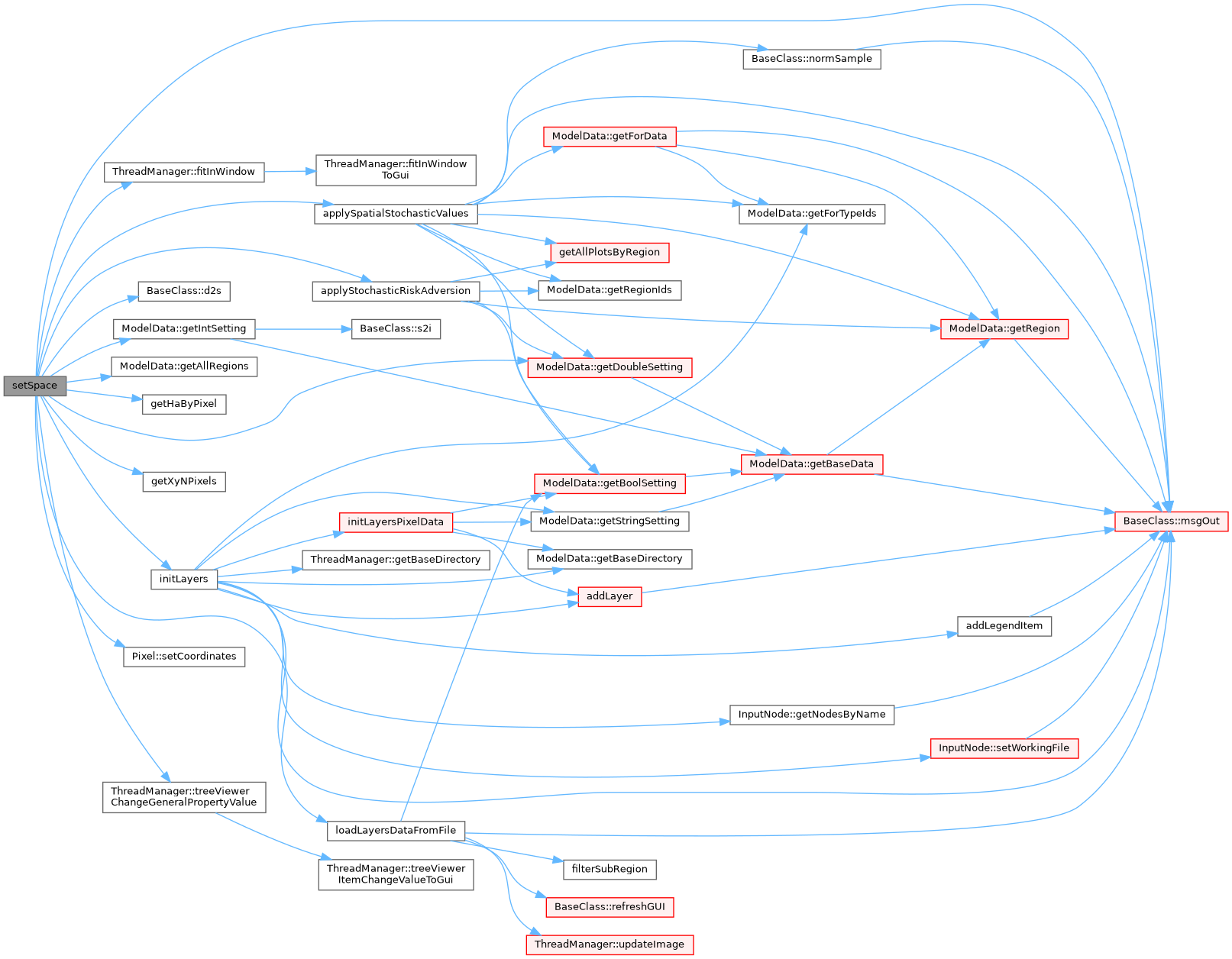
◆ setSpace()

void setSpace ( )

Set the initial space environment, including loading data from files.

setSpace is called directly from the init system to setting the space environment in the model.
It is responsable to:

  • define map dimensions (from setting files)
  • create the pixels
  • initialize the layer
    See also
    initLayers
  • load the layer data from their fdata-files
    See also
    loadLayersDataFromFile
  • tell the GUI that our map will have (x,y) dimensions

Definition at line 57 of file Gis.cpp.

57 {
58
59
60
61 msgOut(MSG_INFO,"Creating the space...");
62
63 // init basic settings....
64 geoTopY = MTHREAD->MD->getDoubleSetting("geoNorthEdge");
65 geoBottomY = MTHREAD->MD->getDoubleSetting("geoSouthEdge");
66 geoLeftX = MTHREAD->MD->getDoubleSetting("geoWestEdge");
67 geoRightX = MTHREAD->MD->getDoubleSetting("geoEastEdge");
68 xNPixels = MTHREAD->MD->getIntSetting("nCols");
69 yNPixels = MTHREAD->MD->getIntSetting("nRows");
70 noValue = MTHREAD->MD->getDoubleSetting("noValue");
76 // creating pixels...
77 for (int i=0;i<yNPixels;i++){
78 for (int j=0;j<xNPixels;j++){
79 Pixel myPixel(i*xNPixels+j, MTHREAD);
80 myPixel.setCoordinates(j,i);
81 pxVector.push_back(myPixel);
82 }
83 }
84 initLayers();
86
87 // Cashing the pixels owned by each region..
88 vector <ModelRegion*> regions = MTHREAD->MD->getAllRegions();
89 int nRegions = regions.size();
90 for(uint i=0;i<nRegions;i++){
91 regions[i]->setMyPixels();
92 }
93
94 applySpatialStochasticValues(); // regional variance -> different tp in each pixel trought tp modifiers
95 applyStochasticRiskAdversion(); // risk adversion to each pixel
96 //cachePixelValues(); // For computational reasons cache some values in the constant layers directly as properties of the pixel object
97
98 //< Print a layer of pixels id..
99 //addLayer("pxIds", "idx of the pixels", true, true, "pxIds.grd", true);
100 //resetLayer("pxIds");
101 //vector<Pixel*> allPixels = getAllPlotsByRegion(11000);
102 //for (int i=0;i<allPixels.size();i++){
103 // int pxId= allPixels[i]->getID();
104 // allPixels[i]->changeValue ("pxIds", pxId);
105 //}
106 //printLayers("pxIds");
107 //exit(1);
108
109 MTHREAD->fitInWindow(); // tell the gui to fit the map to the widget
110// countItems("landUse",false); // count the various records assigned to each legendItem. Do not print debug infos
111 return;
112}
@ MSG_INFO
Print an INFO message.
Definition BaseClass.h:59
double getXyNPixels() const
Return the number of pixels on Y.
Definition Gis.h:131
void applyStochasticRiskAdversion()
Give to each agend a stochastic risk adversion. For now Pixel = Agent.
Definition Gis.cpp:199
double getHaByPixel() const
Return the total number of pixels.
Definition Gis.h:132
void initLayers()
Init the layers.
Definition Gis.cpp:259
void applySpatialStochasticValues()
Apply stochastic simulation, e.g. regional volume growth s.d. -> tp multipliers.
Definition Gis.cpp:121
void loadLayersDataFromFile()
Load the data of a layer its datafile.
Definition Gis.cpp:624
vector< ModelRegion * > getAllRegions(bool excludeResidual=true)
int getIntSetting(const string &name_h, int position=0, int reg=WORLD) const
void treeViewerChangeGeneralPropertyValue(string propertyName, string newValue)

Referenced by Init::setInitLevel1().

Here is the call graph for this function:
Here is the caller graph for this function:

◆ sub2realID()

int sub2realID ( int  id_h)

Transform the ID of a pixel in subregion coordinates to the real (and model used) coordinates.

Definition at line 982 of file Gis.cpp.

982 {
983 // IMPORTANT: this function is called at refreshGUI() times, so if there are output messages, call them with the option to NOT refresh the gui, otherwise we go to an infinite loop...
984 return id_h;
985}

Referenced by ThreadManager::computeQuery().

Here is the caller graph for this function:

◆ swap()

void swap ( const int &  swap_what)

Definition at line 1005 of file Gis.cpp.

1005 {
1006
1007 for(uint i=0;i<pxVector.size();i++) {
1008 pxVector[i].swap(swap_what);
1009 }
1010
1011}

◆ unpack()

void unpack ( const string &  key,
string &  parName,
string &  forName,
string &  dClass,
int &  year 
) const

Definition at line 988 of file Gis.cpp.

988 {
989 int parNameDelimiter = key.find("#",0);
990 int forNameDelimiter = key.find("#",parNameDelimiter+1);
991 int dClassDelimiter = key.find("#",forNameDelimiter+1);
992 int yearDelimiter = key.find("#",dClassDelimiter+1);
993 if (yearDelimiter == string::npos){
994 msgOut(MSG_CRITICAL_ERROR, "Error in unpacking the key for the layer.");
995 }
996 parName.assign(key,0,parNameDelimiter);
997 forName.assign(key,parNameDelimiter+1,forNameDelimiter-parNameDelimiter-1);
998 dClass.assign(key,forNameDelimiter+1,dClassDelimiter-forNameDelimiter-1);
999 string yearString="";
1000 yearString.assign(key,dClassDelimiter+1,yearDelimiter-dClassDelimiter-1);
1001 year = s2i(yearString);
1002}
int s2i(const string &string_h) const
string to integer conversion
Here is the call graph for this function:

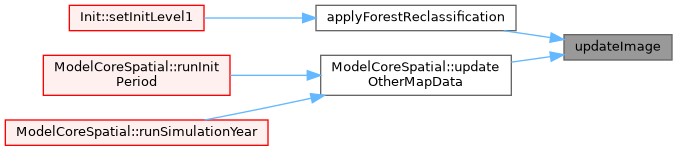
◆ updateImage()

void updateImage ( string  layerName_h)

Add one layer to the system.

Update an ALREADY EXISTING image and send the updated image to the GUI.
It is used instead of updating the individual pixels that is much more time consuming than change the individual pixels value and then upgrade the image as a whole.

Parameters
layername_hLayer from where get the image data

Definition at line 700 of file Gis.cpp.

700 {
701 msgOut (1, "Update image "+layerName_h+"...");
702
703 // sub{X,Y}{R,L,T,B} refer to the subregion coordinates, but when this is not active they coincide with the whole region
704 QImage image = QImage(subXR-subXL+1, subYB-subYT+1, QImage::Format_RGB32);
705
706 image.fill(qRgb(255, 255, 255));
707 int layerIndex=-1;
708 for (uint i=0;i<layerVector.size();i++){
709 if (layerVector.at(i).getName() == layerName_h){
710 layerIndex=i;
711 break;
712 }
713 }
714 if (layerIndex <0) {
715 msgOut(MSG_CRITICAL_ERROR, "Layer not found in Gis::updateImage()");
716 }
717
718 for (int countRow=subYT;countRow<subYB;countRow++){
719 for (int countColumn=subXL;countColumn<subXR;countColumn++){
720 double value = pxVector.at((countRow*xNPixels+countColumn)).getDoubleValue(layerName_h);
721 QColor color = layerVector.at(layerIndex).getColor(value);
722 image.setPixel(countColumn-subXL,countRow-subYT,color.rgb());
723 }
724 }
725 MTHREAD->updateImage(layerName_h,image);
726 refreshGUI();
727}

Referenced by applyForestReclassification(), and ModelCoreSpatial::updateOtherMapData().
Here is the call graph for this function:
Here is the caller graph for this function:

Member Data Documentation

◆ geoBottomY

double geoBottomY
private

geo-coordinates of the map bottom border

Definition at line 169 of file Gis.h.

Referenced by getGeoBottomY(), loadLayersDataFromFile(), and setSpace().

◆ geoLeftX

double geoLeftX
private

geo-coordinates of the map left border

Definition at line 166 of file Gis.h.

Referenced by getGeoLeftX(), loadLayersDataFromFile(), and setSpace().

◆ geoRightX

double geoRightX
private

geo-coordinates of the map right border

Definition at line 168 of file Gis.h.

Referenced by getGeoRightX(), loadLayersDataFromFile(), and setSpace().

◆ geoTopY

double geoTopY
private

geo-coordinates of the map upper border

Definition at line 167 of file Gis.h.

Referenced by getGeoTopY(), loadLayersDataFromFile(), and setSpace().

◆ layerVector

vector<Layers> layerVector
private

◆ lUseTotals

vector<double> lUseTotals
private

totals, in ha, of area in the region for each type (cached values)

Definition at line 160 of file Gis.h.

◆ noValue

double noValue
private

value internally use as novalue (individual layer maps can have other values)

Definition at line 170 of file Gis.h.

Referenced by addLayer(), getNoValue(), loadLayersDataFromFile(), printDebugValues(), resetLayer(), and setSpace().

◆ pxVector

◆ subXL

int subXL
private

sub region left X

Definition at line 171 of file Gis.h.

Referenced by filterSubRegion(), getSubXL(), and updateImage().

◆ subXR

int subXR
private

sub region right X

Definition at line 172 of file Gis.h.

Referenced by filterSubRegion(), getSubXR(), and updateImage().

◆ subYB

int subYB
private

sub region bottom Y

Definition at line 174 of file Gis.h.

Referenced by filterSubRegion(), getSubYB(), and updateImage().

◆ subYT

int subYT
private

sub region top Y

Definition at line 173 of file Gis.h.

Referenced by filterSubRegion(), getSubYT(), and updateImage().

◆ xMetersByPixel

double xMetersByPixel
private

pixel dimension (meters), X

Definition at line 164 of file Gis.h.

Referenced by getDistance(), getHaByPixel(), getXMetersByPixel(), and setSpace().

◆ xNPixels

int xNPixels
private

number of pixels along the X dimension

Definition at line 161 of file Gis.h.

Referenced by filterSubRegion(), getPixel(), getXNPixels(), loadLayersDataFromFile(), setSpace(), and updateImage().

◆ xyNPixels

double xyNPixels
private

total number of pixels

Definition at line 163 of file Gis.h.

Referenced by addLayer(), applyForestReclassification(), getXyNPixels(), resetLayer(), and setSpace().

◆ yMetersByPixel

double yMetersByPixel
private

pixel dimension (meters), Y

Definition at line 165 of file Gis.h.

Referenced by getDistance(), getHaByPixel(), getYMetersByPixel(), and setSpace().

◆ yNPixels

int yNPixels
private

number of pixels along the Y dimension

Definition at line 162 of file Gis.h.

Referenced by filterSubRegion(), getYNPixels(), loadLayersDataFromFile(), and setSpace().


The documentation for this class was generated from the following files: