FFSM++ 1.1.0
French Forest Sector Model ++
Loading...
Searching...
No Matches
Ipopt_nlp_problem_debugtest Class Reference

#include <Ipopt_nlp_problem_debugtest.h>
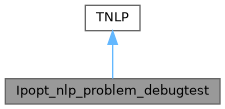
Inheritance diagram for Ipopt_nlp_problem_debugtest:
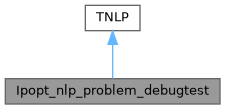
Collaboration diagram for Ipopt_nlp_problem_debugtest:

Public Member Functions

 Ipopt_nlp_problem_debugtest ()
 
virtual ~Ipopt_nlp_problem_debugtest ()
 
Overloaded from TNLP
virtual bool get_nlp_info (Index &n, Index &m, Index &nnz_jac_g, Index &nnz_h_lag, IndexStyleEnum &index_style)
 
virtual bool get_bounds_info (Index n, Number *x_l, Number *x_u, Index m, Number *g_l, Number *g_u)
 
virtual bool get_starting_point (Index n, bool init_x, Number *x, bool init_z, Number *z_L, Number *z_U, Index m, bool init_lambda, Number *lambda)
 
virtual bool eval_f (Index n, const Number *x, bool new_x, Number &obj_value)
 
virtual bool eval_grad_f (Index n, const Number *x, bool new_x, Number *grad_f)
 
virtual bool eval_g (Index n, const Number *x, bool new_x, Index m, Number *g)
 
virtual bool eval_jac_g (Index n, const Number *x, bool new_x, Index m, Index nele_jac, Index *iRow, Index *jCol, Number *values)
 
virtual bool eval_h (Index n, const Number *x, bool new_x, Number obj_factor, Index m, const Number *lambda, bool new_lambda, Index nele_hess, Index *iRow, Index *jCol, Number *values)
 
Solution Methods
virtual void finalize_solution (SolverReturn status, Index n, const Number *x, const Number *z_L, const Number *z_U, Index m, const Number *g, const Number *lambda, Number obj_value, const IpoptData *ip_data, IpoptCalculatedQuantities *ip_cq)
 

Private Member Functions

Methods to block default compiler methods.

The compiler automatically generates the following three methods. Since the default compiler implementation is generally not what you want (for all but the most simple classes), we usually put the declarations of these methods in the private section and never implement them. This prevents the compiler from implementing an incorrect "default" behavior without us knowing. (See Scott Meyers book, "Effective C++")

 Ipopt_nlp_problem_debugtest (const Ipopt_nlp_problem_debugtest &)
 
Ipopt_nlp_problem_debugtestoperator= (const Ipopt_nlp_problem_debugtest &)
 

Detailed Description

C++ Example NLP for interfacing a problem with IPOPT. HS071_NLP implements a C++ example of problem 71 of the Hock-Schittkowski test suite. This example is designed to go along with the tutorial document and show how to interface with IPOPT through the TNLP interface.

Problem hs071 looks like this

min   x1*x4*(x1 + x2 + x3)  +  x3
s.t.  x1*x2*x3*x4                   >=  25
      x1**2 + x2**2 + x3**2 + x4**2  =  40
      1 <=  x1,x2,x3,x4  <= 5

Starting point:
   x = (1, 5, 5, 1)

Optimal solution:
   x = (1.00000000, 4.74299963, 3.82114998, 1.37940829)

Definition at line 29 of file Ipopt_nlp_problem_debugtest.h.

Constructor & Destructor Documentation

◆ Ipopt_nlp_problem_debugtest() [1/2]

default constructor

Definition at line 9 of file Ipopt_nlp_problem_debugtest.cpp.

10{}

◆ ~Ipopt_nlp_problem_debugtest()

default destructor

Definition at line 13 of file Ipopt_nlp_problem_debugtest.cpp.

14{}

◆ Ipopt_nlp_problem_debugtest() [2/2]

Member Function Documentation

◆ eval_f()

bool eval_f ( Index  n,
const Number *  x,
bool  new_x,
Number &  obj_value 
)
virtual

Method to return the objective value

Definition at line 96 of file Ipopt_nlp_problem_debugtest.cpp.

97{
98 assert(n == 4);
99
100 obj_value = x[0] * x[3] * (x[0] + x[1] + x[2]) + x[2];
101
102 return true;
103}

◆ eval_g()

bool eval_g ( Index  n,
const Number *  x,
bool  new_x,
Index  m,
Number *  g 
)
virtual

Method to return the constraint residuals

Definition at line 119 of file Ipopt_nlp_problem_debugtest.cpp.

120{
121 assert(n == 4);
122 assert(m == 2);
123
124 g[0] = x[0] * x[1] * x[2] * x[3];
125 g[1] = x[0]*x[0] + x[1]*x[1] + x[2]*x[2] + x[3]*x[3];
126
127 return true;
128}

◆ eval_grad_f()

bool eval_grad_f ( Index  n,
const Number *  x,
bool  new_x,
Number *  grad_f 
)
virtual

Method to return the gradient of the objective

Definition at line 106 of file Ipopt_nlp_problem_debugtest.cpp.

107{
108 assert(n == 4);
109
110 grad_f[0] = x[0] * x[3] + x[3] * (x[0] + x[1] + x[2]);
111 grad_f[1] = x[0] * x[3];
112 grad_f[2] = x[0] * x[3] + 1;
113 grad_f[3] = x[0] * (x[0] + x[1] + x[2]);
114
115 return true;
116}

◆ eval_h()

bool eval_h ( Index  n,
const Number *  x,
bool  new_x,
Number  obj_factor,
Index  m,
const Number *  lambda,
bool  new_lambda,
Index  nele_hess,
Index *  iRow,
Index *  jCol,
Number *  values 
)
virtual

Method to return: 1) The structure of the hessian of the lagrangian (if "values" is NULL) 2) The values of the hessian of the lagrangian (if "values" is not NULL)

Definition at line 175 of file Ipopt_nlp_problem_debugtest.cpp.

179{
180 if (values == NULL) {
181 // return the structure. This is a symmetric matrix, fill the lower left
182 // triangle only.
183
184 // the hessian for this problem is actually dense
185 Index idx=0;
186 for (Index row = 0; row < 4; row++) {
187 for (Index col = 0; col <= row; col++) {
188 iRow[idx] = row;
189 jCol[idx] = col;
190 idx++;
191 }
192 }
193
194 assert(idx == nele_hess);
195 }
196 else {
197 // return the values. This is a symmetric matrix, fill the lower left
198 // triangle only
199
200 // fill the objective portion
201 values[0] = obj_factor * (2*x[3]); // 0,0
202
203 values[1] = obj_factor * (x[3]); // 1,0
204 values[2] = 0.; // 1,1
205
206 values[3] = obj_factor * (x[3]); // 2,0
207 values[4] = 0.; // 2,1
208 values[5] = 0.; // 2,2
209
210 values[6] = obj_factor * (2*x[0] + x[1] + x[2]); // 3,0
211 values[7] = obj_factor * (x[0]); // 3,1
212 values[8] = obj_factor * (x[0]); // 3,2
213 values[9] = 0.; // 3,3
214
215
216 // add the portion for the first constraint
217 values[1] += lambda[0] * (x[2] * x[3]); // 1,0
218
219 values[3] += lambda[0] * (x[1] * x[3]); // 2,0
220 values[4] += lambda[0] * (x[0] * x[3]); // 2,1
221
222 values[6] += lambda[0] * (x[1] * x[2]); // 3,0
223 values[7] += lambda[0] * (x[0] * x[2]); // 3,1
224 values[8] += lambda[0] * (x[0] * x[1]); // 3,2
225
226 // add the portion for the second constraint
227 values[0] += lambda[1] * 2; // 0,0
228
229 values[2] += lambda[1] * 2; // 1,1
230
231 values[5] += lambda[1] * 2; // 2,2
232
233 values[9] += lambda[1] * 2; // 3,3
234 }
235
236 return true;
237}

◆ eval_jac_g()

bool eval_jac_g ( Index  n,
const Number *  x,
bool  new_x,
Index  m,
Index  nele_jac,
Index *  iRow,
Index *  jCol,
Number *  values 
)
virtual

Method to return: 1) The structure of the jacobian (if "values" is NULL) 2) The values of the jacobian (if "values" is not NULL)

Definition at line 131 of file Ipopt_nlp_problem_debugtest.cpp.

134{
135 if (values == NULL) {
136 // return the structure of the jacobian
137
138 // this particular jacobian is dense
139 iRow[0] = 0;
140 jCol[0] = 0;
141 iRow[1] = 0;
142 jCol[1] = 1;
143 iRow[2] = 0;
144 jCol[2] = 2;
145 iRow[3] = 0;
146 jCol[3] = 3;
147 iRow[4] = 1;
148 jCol[4] = 0;
149 iRow[5] = 1;
150 jCol[5] = 1;
151 iRow[6] = 1;
152 jCol[6] = 2;
153 iRow[7] = 1;
154 jCol[7] = 3;
155 }
156 else {
157 // return the values of the jacobian of the constraints
158
159 values[0] = x[1]*x[2]*x[3]; // 0,0
160 values[1] = x[0]*x[2]*x[3]; // 0,1
161 values[2] = x[0]*x[1]*x[3]; // 0,2
162 values[3] = x[0]*x[1]*x[2]; // 0,3
163
164 values[4] = 2*x[0]; // 1,0
165 values[5] = 2*x[1]; // 1,1
166 values[6] = 2*x[2]; // 1,2
167 values[7] = 2*x[3]; // 1,3
168 }
169
170 return true;
171}

◆ finalize_solution()

void finalize_solution ( SolverReturn  status,
Index  n,
const Number *  x,
const Number *  z_L,
const Number *  z_U,
Index  m,
const Number *  g,
const Number *  lambda,
Number  obj_value,
const IpoptData *  ip_data,
IpoptCalculatedQuantities *  ip_cq 
)
virtual

This method is called when the algorithm is complete so the TNLP can store/write the solution

Definition at line 241 of file Ipopt_nlp_problem_debugtest.cpp.

247{
248 // here is where we would store the solution to variables, or write to a file, etc
249 // so we could use the solution.
250
251 // For this example, we write the solution to the console
252 std::cout << std::endl << std::endl << "Solution of the primal variables, x" << std::endl;
253 for (Index i=0; i<n; i++) {
254 std::cout << "x[" << i << "] = " << x[i] << std::endl;
255 }
256
257 std::cout << std::endl << std::endl << "Solution of the bound multipliers, z_L and z_U" << std::endl;
258 for (Index i=0; i<n; i++) {
259 std::cout << "z_L[" << i << "] = " << z_L[i] << std::endl;
260 }
261 for (Index i=0; i<n; i++) {
262 std::cout << "z_U[" << i << "] = " << z_U[i] << std::endl;
263 }
264
265 std::cout << std::endl << std::endl << "Objective value" << std::endl;
266 std::cout << "f(x*) = " << obj_value << std::endl;
267
268 std::cout << std::endl << "Final value of the constraints:" << std::endl;
269 for (Index i=0; i<m ;i++) {
270 std::cout << "g(" << i << ") = " << g[i] << std::endl;
271 }
272}

◆ get_bounds_info()

bool get_bounds_info ( Index  n,
Number *  x_l,
Number *  x_u,
Index  m,
Number *  g_l,
Number *  g_u 
)
virtual

Method to return the bounds for my problem

Definition at line 40 of file Ipopt_nlp_problem_debugtest.cpp.

42{
43 // here, the n and m we gave IPOPT in get_nlp_info are passed back to us.
44 // If desired, we could assert to make sure they are what we think they are.
45 assert(n == 4);
46 assert(m == 2);
47
48 // the variables have lower bounds of 1
49 for (Index i=0; i<4; i++) {
50 x_l[i] = 1.0;
51 }
52
53 // the variables have upper bounds of 5
54 for (Index i=0; i<4; i++) {
55 x_u[i] = 5.0;
56 }
57
58 // the first constraint g1 has a lower bound of 25
59 g_l[0] = 25;
60 // the first constraint g1 has NO upper bound, here we set it to 2e19.
61 // Ipopt interprets any number greater than nlp_upper_bound_inf as
62 // infinity. The default value of nlp_upper_bound_inf and nlp_lower_bound_inf
63 // is 1e19 and can be changed through ipopt options.
64 g_u[0] = 2e19;
65
66 // the second constraint g2 is an equality constraint, so we set the
67 // upper and lower bound to the same value
68 g_l[1] = g_u[1] = 40.0;
69
70 return true;
71}

◆ get_nlp_info()

bool get_nlp_info ( Index &  n,
Index &  m,
Index &  nnz_jac_g,
Index &  nnz_h_lag,
IndexStyleEnum &  index_style 
)
virtual

Method to return some info about the nlp

Definition at line 17 of file Ipopt_nlp_problem_debugtest.cpp.

19{
20 // The problem described in Ipopt_nlp_problem_debugtest.hpp has 4 variables, x[0] through x[3]
21 n = 4;
22
23 // one equality constraint and one inequality constraint
24 m = 2;
25
26 // in this example the jacobian is dense and contains 8 nonzeros
27 nnz_jac_g = 8;
28
29 // the hessian is also dense and has 16 total nonzeros, but we
30 // only need the lower left corner (since it is symmetric)
31 nnz_h_lag = 10;
32
33 // use the C style indexing (0-based)
34 index_style = TNLP::C_STYLE;
35
36 return true;
37}

◆ get_starting_point()

bool get_starting_point ( Index  n,
bool  init_x,
Number *  x,
bool  init_z,
Number *  z_L,
Number *  z_U,
Index  m,
bool  init_lambda,
Number *  lambda 
)
virtual

Method to return the starting point for the algorithm

Definition at line 74 of file Ipopt_nlp_problem_debugtest.cpp.

78{
79 // Here, we assume we only have starting values for x, if you code
80 // your own NLP, you can provide starting values for the dual variables
81 // if you wish
82 assert(init_x == true);
83 assert(init_z == false);
84 assert(init_lambda == false);
85
86 // initialize to the given starting point
87 x[0] = 1.0;
88 x[1] = 5.0;
89 x[2] = 5.0;
90 x[3] = 1.0;
91
92 return true;
93}

◆ operator=()

Ipopt_nlp_problem_debugtest & operator= ( const Ipopt_nlp_problem_debugtest )
private

The documentation for this class was generated from the following files: