FFSM++ 1.1.0
French Forest Sector Model ++
Loading...
Searching...
No Matches
output_parser_lib Namespace Reference

Functions

 prepare_data ()
 
 reset_output ()
 
 plotMultivariable (scenarios_h, variables_h, region, title, filename, printLegend=True, fwidth=10, fheight=15)
 
 plotCarbonChart (scenarios_h, region, title, filename)
 
 plotLegend (scenarios_h, filename, title_h="")
 
 plotVectorChart_inner (origin, end1, endt, xlabel, ylabel, filename, comp1_color='red', totcomp_color='blue', diffcomp_color='green')
 
 printTable (ref_scenario, comparing_scenarios, variables_h, regions_h, years_h, title, filename, singleComparation=False, refYear=0)
 
 printAATable (ref_scenarios, comparing_scenarios, regions_h, years_h, title, filename, refYear=0)
 
 printCarbonTable (ref_scenario, comparing_scenarios, region, year_start, year_end, title, filename, avg=False, singleComparation=True)
 
 printTableRecord (cvar_label, d, el, nscen, valRScenario, valCScenarios, singleComparation)
 
 title (cat, level, title)
 
 text (cat, text_h)
 
 myunicode (astring)
 

Function Documentation

◆ myunicode()

myunicode (   astring)

Definition at line 868 of file output_parser_lib.py.

868def myunicode(astring):
869 if sys.version_info < (3, 0):
870 return unicode(astring, 'utf_8')
871 else:
872 return astring

Referenced by plotCarbonChart(), plotLegend(), plotMultivariable(), and plotVectorChart_inner().
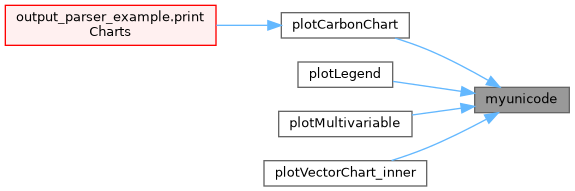
Here is the caller graph for this function:

◆ plotCarbonChart()

plotCarbonChart (   scenarios_h,
  region,
  title,
  filename 
)

Definition at line 278 of file output_parser_lib.py.

278def plotCarbonChart(scenarios_h,region,title, filename):
279#def plotMultivariable(scenarios_h, variables_h, region, title, filename, printLegend=True):
280
281
282 cVariables = [
283 ['Forest pool', ['STOCK_INV','STOCK_EXTRA'],':',3,'#314004'],
284 ['Wood products pool', ['STOCK_PRODUCTS'],'--',3,'#7f0021'],
285 ['Net cumulative substitution effect', ['EM_ENSUB','EM_MATSUB','EM_FOROP'],'-',4,'#83caff'],
286 ]
287
288 nscen = len(scenarios_h)
289
290
291 matplotlib.rcParams.update({'font.size': 22})
292
293
294 fig = plt.gcf()
295 fig.set_size_inches(12,10)
296 ylabel = myunicode("Gt CO2 eq")
297 plt.title(myunicode(title))
298 plt.ylabel(ylabel)
299
300 totals = [[0]*len(g.x)]* nscen
301
302 if nscen > 1: #normal line plots
303 for idg, cGroup in enumerate(cVariables):
304 for ids, scenario in enumerate(scenarios_h):
305 grTotals = [0]*len(g.x)
306 #serieName = myunicode(cGroup[0] + " - " + scenario)
307 serieName = "_"+myunicode(scenario) # not shown in legend
308 if idg==2:
309 serieName = myunicode(scenario)
310 serieColor = g.scenarios[scenario]
311 serieLineType = cGroup[2]
312 serieWidth = cGroup[3]
313 for var in cGroup[1]: # for idx, var in enumerate(cGroup[1]):
314 key = region, var, scenario, ""
315 varData = g.odata[key]
316 grTotals = [x2+y for x2, y in zip(grTotals, varData)]
317
318 totals[ids] = [x3+y2 for x3, y2 in zip(totals[ids],grTotals)]
319 y = [x4 / 1000 for x4 in totals[ids]]
320 plt.plot(g.x, y, serieLineType, label=serieName, linewidth=serieWidth, color=serieColor)
321 else: #area stacked plot
322 fillColours = []
323 y = []
324 for cGroup in cVariables:
325 y_local = np.zeros(len(g.x))
326 fillColour = cGroup[4]
327 for var in cGroup[1]: # for idx, var in enumerate(cGroup[1]):
328 key = region, var, scenarios_h[0], ""
329 varData = np.array(g.odata[key])
330 #y_local += varData # For some reasons this doesn't work
331 y_local = [t+(a/1000) for t, a in zip(y_local, varData)]
332 y.append(y_local)
333 fillColours.append(fillColour)
334 for cGroup in reversed(cVariables):
335 serieName = myunicode(cGroup[0])
336 fillColour = cGroup[4]
337 plt.plot([], [], color=fillColour, linewidth=4, label=serieName) # plotting emply data hack as stackplot doesn't support the legend
338
339 ax = fig.add_subplot(111)
340 ax.stackplot(g.x, y, colors=fillColours, edgecolor = "none")
341 ax.autoscale_view('tight')
342
343 #plt.legend(loc='lower right', ncol=3, shadow=False, labelspacing=0., prop={'size':12})
344 plt.legend(loc='lower right', ncol=1, shadow=False, labelspacing=0., prop={'size':14})
345 #plt.ylim([0,18]) # This would scale the plot y axis to the desired ranges
346 plt.savefig(g.chartoutdir+"/"+filename+"_"+region+"."+g.charttype, dpi=300)
347 #plt.show()
348 plt.close()
349
350 omasterfilename = g.chartoutdir+'/'+g.chartsmaster+'.tex'
351 omfile = open(omasterfilename,'a')
352 omfile.write("\\begin{figure}[htbp]\n")
353 omfile.write(" \\centering\n")
354 omfile.write(" \\caption{"+title+"}\n")
355 omfile.write(" \\includegraphics[width=0.8\\textwidth]{\""+g.chartoutdir+"/"+filename+"_"+region+"\"}\n")
356 omfile.write(" \\label{fig:"+filename+"}\n")
357 omfile.write("\\end{figure}\n")
358 omfile.close()
359
360"""
361 scenTotals
362 y = odata[key]
363 plt.plot(x, y, serieLineType, label=serieName, linewidth=serieWidth, color=serieColor)
364 handles, labels = ax.get_legend_handles_labels()
365 #plt.subplots_adjust(hspace=0.6)
366 #handles, labels = ax.get_legend_handles_labels()
367 #ax.legend(handles, labels, ncol=3, shadow=False, title="Legend")
368 if printLegend:
369 plt.figlegend(handles, labels, loc = 'lower center', ncol=3, shadow=False, labelspacing=0., prop={'size':12})
370 #plt.savefig(chartoutdir+"/"+filename+"_"+region+"."+charttype, bbox_inches='tight', dpi=300)
371 plt.savefig(chartoutdir+"/"+filename+"_"+region+"."+charttype, dpi=300)
372 #plt.show()
373 plt.close()
374
375 omasterfilename = chartoutdir+'/'+chartsmaster+'.tex'
376 omfile = open(omasterfilename,'a')
377 omfile.write("\\begin{figure}[htbp]\n")
378 omfile.write(" \\centering\n")
379 omfile.write(" \\caption{"+title+"}\n")
380 omfile.write(" \\includegraphics[width=0.8\\textwidth]{"+chartoutdir+"/"+filename+"_"+region+"}\n")
381 omfile.write(" \\label{fig:"+filename+"}\n")
382 omfile.write("\\end{figure}\n")
383 omfile.close()
384 """
385
386# =============================================================================

Referenced by output_parser_example.printCharts().

Here is the call graph for this function:
Here is the caller graph for this function:

◆ plotLegend()

plotLegend (   scenarios_h,
  filename,
  title_h = "" 
)

Definition at line 387 of file output_parser_lib.py.

387def plotLegend(scenarios_h, filename, title_h=""):
388 nscen = len(scenarios_h)
389 fig = plt.gcf()
390 fheight = (15/15)*nscen+0.2
391 fig.set_size_inches(10,fheight)
392 #ax = plt.axes()
393 #ax.set_axis_off()
394
395 #fig = plt.figure()
396 ax =fig.add_subplot(111)
397 ax.set_axis_off()
398
399 for spGroup in sorted(g.spAggregates.keys()):
400 for scenario in scenarios_h:
401 serieName = myunicode(spGroup + " - " + scenario)
402 serieColor = g.scenarios[scenario]
403 serieLineType = g.spAggregates[spGroup][1]
404 serieWidth = g.spAggregates[spGroup][2]
405 #print serieName+ " - " + serieLineType + " - " + str(serieWidth)
406 dummyx = [1]
407 dummyy = [1]
408 plt.plot(dummyx, dummyy, serieLineType, label=serieName, linewidth=serieWidth, color=serieColor)
409 handles, labels = ax.get_legend_handles_labels()
410 ax.legend(handles, labels, ncol=3, shadow=False) # removed title=title_h
411 plt.savefig(g.chartoutdir+"/"+filename+"."+g.charttype, bbox_inches='tight', pad_inches=0.1, dpi=300)
412 #plt.show()
413 plt.close()
414
415 omasterfilename = g.chartoutdir+'/'+g.chartsmaster+'.tex'
416 omfile = open(omasterfilename,'a')
417 omfile.write("\\begin{figure}[htbp]\n")
418 omfile.write(" \\centering\n")
419 omfile.write(" \\caption{"+title_h+"}\n")
420 omfile.write(" \\includegraphics[width=0.8\\textwidth]{\""+g.chartoutdir+"/"+filename+"\"}\n")
421 omfile.write(" \\label{fig:"+filename+"}\n")
422 omfile.write("\\end{figure}\n")
423 omfile.close()
424
425#import matplotlib.pyplot as plt
426#ax = plt.subplot() #create the axes
427#ax.set_axis_off() #turn off the axis
428#.... #do patches and labels
429#ax.legend(patches, labels, ...) #legend alone in the figure
430#plt.show()
431
432# =============================================================================
Here is the call graph for this function:

◆ plotMultivariable()

plotMultivariable (   scenarios_h,
  variables_h,
  region,
  title,
  filename,
  printLegend = True,
  fwidth = 10,
  fheight = 15 
)

Definition at line 223 of file output_parser_lib.py.

223def plotMultivariable(scenarios_h, variables_h, region, title, filename, printLegend=True, fwidth=10, fheight=15):
224
225 nvar = len(variables_h)
226 nscen = len(scenarios_h)
227 #plt.figure(1)
228 fig = plt.gcf()
229 # suggested: fheight = (15/5)*nvar+0.2
230 #if nvar == 1:
231 # fheight = 4
232 #if nvar == 2:
233 # fheight = 8
234 fig.set_size_inches(10,fheight) # 15 inches height is fine with 4 variables
235 maintitle = myunicode(title)
236 handles =[]
237 labels = []
238 #plt.suptitle(maintitle, fontsize=16, ha='center')
239 for i in range(nvar):
240 #plt.subplot(nvar,1,i+1)
241 ax =fig.add_subplot(nvar,1,i+1)
242 subplotTitle = myunicode(g.forVars[variables_h[i]][0])
243 ylabel = myunicode(g.forVars[variables_h[i]][1])
244 plt.title(subplotTitle)
245 plt.ylabel(ylabel)
246 for spGroup in sorted(g.spAggregates.keys()):
247 for scenario in scenarios_h:
248 serieName = myunicode(spGroup + " - " + scenario)
249 serieColor = g.scenarios[scenario]
250 serieLineType = g.spAggregates[spGroup][1]
251 serieWidth = g.spAggregates[spGroup][2]
252 #print serieName+ " - " + serieLineType + " - " + str(serieWidth)
253 key = region, variables_h[i], scenario, spGroup
254 y = g.odata[key]
255 plt.plot(g.x, y, serieLineType, label=serieName, linewidth=serieWidth, color=serieColor)
256 handles, labels = ax.get_legend_handles_labels()
257 #plt.subplots_adjust(hspace=0.6)
258 #handles, labels = ax.get_legend_handles_labels()
259 #ax.legend(handles, labels, ncol=3, shadow=False, title="Legend")
260 if printLegend:
261 plt.figlegend(handles, labels, loc = 'lower center', ncol=3, shadow=False, labelspacing=0., prop={'size':12})
262 #plt.savefig(chartoutdir+"/"+filename+"_"+region+"."+charttype, bbox_inches='tight', dpi=300)
263 plt.savefig(g.chartoutdir+"/"+filename+"_"+region+"."+g.charttype, dpi=300)
264 #plt.show()
265 plt.close()
266
267 omasterfilename = g.chartoutdir+'/'+g.chartsmaster+'.tex'
268 omfile = open(omasterfilename,'a')
269 omfile.write("\\begin{figure}[htbp]\n")
270 omfile.write(" \\centering\n")
271 omfile.write(" \\caption{"+title+"}\n")
272 omfile.write(" \\includegraphics[width=0.8\\textwidth]{\""+g.chartoutdir+"/"+filename+"_"+region+"\"}\n")
273 omfile.write(" \\label{fig:"+filename+"}\n")
274 omfile.write("\\end{figure}\n")
275 omfile.close()
276
277# =============================================================================
Here is the call graph for this function:

◆ plotVectorChart_inner()

plotVectorChart_inner (   origin,
  end1,
  endt,
  xlabel,
  ylabel,
  filename,
  comp1_color = 'red',
  totcomp_color = 'blue',
  diffcomp_color = 'green' 
)
Plot a 2-d vector difference
# @params:
# origin: x and y of the origin of the vectors
# end1:  (x,y) coordinates of the ending of the first component vector
# end2:  (x,y) coordinates of the ending of the total component of the vector
# xlabel: xlabel
# ylabel: ylabel
# filename: filename
# totcomp_color: color (English or #HTML_code) of the vector representing the total component
# comp1_color: color (English or #HTML_code) of the vector representing the first component
# diffcomp_color: color (English or #HTML_code) of the vector representing the difference component

Definition at line 433 of file output_parser_lib.py.

433def plotVectorChart_inner(origin,end1,endt,xlabel,ylabel,filename, comp1_color='red', totcomp_color='blue', diffcomp_color='green'):
434 '''
435 Plot a 2-d vector difference
436 # @params:
437 # origin: x and y of the origin of the vectors
438 # end1: (x,y) coordinates of the ending of the first component vector
439 # end2: (x,y) coordinates of the ending of the total component of the vector
440 # xlabel: xlabel
441 # ylabel: ylabel
442 # filename: filename
443 # totcomp_color: color (English or #HTML_code) of the vector representing the total component
444 # comp1_color: color (English or #HTML_code) of the vector representing the first component
445 # diffcomp_color: color (English or #HTML_code) of the vector representing the difference component
446 '''
447
448 matplotlib.rc('xtick', labelsize=30)
449 matplotlib.rc('ytick', labelsize=30)
450 matplotlib.rcParams.update({'font.size': 26})
451
452 a = plt.figure()
453 ax = plt.gca()
454 fig = plt.gcf()
455 flag_2d = True
456 if(origin[0] == end1[0] == endt[0]):
457 flag_2d = False;
458 fig.set_size_inches(6,10)
459 else:
460 fig.set_size_inches(10,10)
461 end2 = (endt[0]-end1[0]+origin[0],endt[1]-end1[1]+origin[1])
462 minx = min(origin[0],end1[0],end2[0],endt[0])
463 maxx = max(origin[0],end1[0],end2[0],endt[0])
464 miny = min(origin[1],end1[1],end2[1],endt[1])
465 maxy = max(origin[1],end1[1],end2[1],endt[1])
466 centre = (((maxx-minx)/2)+minx,((maxy-miny)/2)+miny)
467
468 # This allows to write a serie of arrows in one go, but didn't got how in this case colours work
469 #X = (origin[0], origin[0], origin[0])
470 #Y = (origin[1], origin[1], origin[1])
471 #X2 = (end1[0]-origin[0], endt[0]-origin[0], end2[0]-origin[0])
472 #Y2 = (end1[1]-origin[1], endt[1]-origin[1], end2[1]-origin[1])
473 #C = (255,10,150) # ? colour codes, but didn't got it
474 # ax.quiver(X,Y,X2,Y2,Cangles='xy',scale_units='xy',scale=1, width=0.008)
475
476 # Printing first component..
477 ax.quiver(origin[0],origin[1],end1[0]-origin[0],end1[1]-origin[1],angles='xy',scale_units='xy',scale=1, width=0.008, color=comp1_color)
478 # Printing total component..
479 ax.quiver(origin[0],origin[1],endt[0]-origin[0],endt[1]-origin[1],angles='xy',scale_units='xy',scale=1, width=0.02, color=totcomp_color)
480 # Printing diff component..
481 ax.quiver(origin[0],origin[1],end2[0]-origin[0],end2[1]-origin[1],angles='xy',scale_units='xy',scale=1, width=0.008, color=diffcomp_color)
482
483 x = (end1[0],end2[0])
484 y = (end1[1],end2[1])
485 x2 = (endt[0]-end1[0], endt[0]-end2[0])
486 y2 = (endt[1]-end1[1], endt[1]-end2[1])
487
488 if(flag_2d):
489 ax.quiver(x,y,x2,y2,angles='xy',scale_units='xy',scale=1, linestyle='dotted', facecolor='none', linewidth=2, color='gray', edgecolors='k', width=0.0001, headwidth=300, headlength=500)
490 ax.set_xlim([minx- (centre[0]-minx)*0.4, maxx + (maxx-centre[0])*0.4])
491
492 ax.set_ylim([miny- (centre[1]-miny)*0.4, maxy + (maxy-centre[1])*0.4])
493
494 plt.xlabel(myunicode(xlabel))
495 plt.ylabel(myunicode(ylabel))
496 # Uncomment the following lines if you want to display instead of save the figure..
497 #plt.draw()
498 #plt.show()
499 plt.savefig(filename, dpi=300, transparent=False, bbox_inches='tight', pad_inches=0.1)
500
501
502# =============================================================================
Here is the call graph for this function:

◆ prepare_data()

prepare_data ( )

Definition at line 19 of file output_parser_lib.py.

19def prepare_data():
20 #print ("Loading and preparing the data..")
21
22 # A - creating empty dictionaries with just the keys..
23 for country, data in g.countries.items():
24 g.regions[country] = data[1] # add 11000: 'France' to regions
25 g.sortedregions = sorted(g.regions)
26 #k = d.keys(); k.sort(). Use k = sorted(d)
27
28 specieswithAggregates = g.spGroups
29 specieswithAggregates.extend(g.spAggregates.keys())
30 tempSpecieswithAggregates = specieswithAggregates
31 #tempSpecieswithAggregates.append("") # attenction that python doesn not create a new variable, just alias the two
32 tempSpGroups = g.spGroups
33 tempSpGroups.append("")
34
35
36 variablesWithAggregates = list(g.forVars.keys())
37 for variable in g.forVars.keys():
38 #'expReturns': ['Expected returns','€/ha','forArea','totalExpReturns','globalft'],
39 if len(g.forVars[variable]) >= 3:
40 variablesWithAggregates.append(g.forVars[variable][3])
41
42 for region in g.regions.keys():
43 for variable in variablesWithAggregates:
44 for scenario in g.scenarios.keys():
45 for spGroup in tempSpecieswithAggregates:
46 for year in g.years:
47 key = region, variable, scenario, spGroup, year
48 g.idata[key] = 0.0
49 for region in g.regions.keys():
50 for variable in variablesWithAggregates:
51 for scenario in g.scenarios.keys():
52 for spGroup in tempSpecieswithAggregates:
53 key = region, variable, scenario, spGroup
54 g.odata[key] = []
55 for year in g.years:
56 g.x.append(int(year))
57
58
59 # B - loading data..
60 for ifile in g.forIFiles:
61 idata_raw = csv.DictReader(open(ifile, 'r'), delimiter=g.sep)
62 for rec in idata_raw:
63 # scen;parName;country;region;forType;diamClass;year;value;
64 iForType = rec['forType']
65 if iForType == 'broadL':
66 debug = True
67 for spAggregateKey, spAggregate in g.spAggregates.items():
68 if (len(spAggregate) >= 3 and iForType == spAggregate[3]):
69 iForType = spAggregateKey
70 break
71 key = rec['region'],rec['parName'],rec['scen'],iForType,rec['year']
72 if key in g.idata:
73 g.idata[key] += float (rec['value'])
74 debug = g.idata
75 for ifile in g.prodIFiles:
76 idata_raw = csv.DictReader(open(ifile, 'r'), delimiter=g.sep)
77 for rec in idata_raw:
78 # scen;parName;country;region;prod;freeDim;year;value;
79 key = rec['region'],rec['parName'],rec['scen'],rec['prod'],rec['year']
80 if key in g.idata:
81 g.idata[key] += float (rec['value'])
82
83 for ifile in g.carbonIFiles:
84 #print (g.carbonIFiles)
85 idata_raw = csv.DictReader(open(ifile, 'r'), delimiter=g.sep)
86 for rec in idata_raw:
87 # scen;parName;country;region;forType;diamClass;year;value;
88 key = rec['region'],rec['balItem'],rec['scen'],"",rec['year']
89 #print key
90 if key in g.idata:
91 g.idata[key] += float (rec['value'])
92 #print (key)
93 #print (g.idata[key])
94
95 #exit(1)
96
97 # C - creating aggregated data for variables that need to be pondered
98# for variable in g.forVars.keys():
99# #'expReturns': ['Expected returns','€/ha','forArea', 'totalExpReturns'],
100# if len(g.forVars[variable]) >= 3:
101# pondVariable = g.forVars[variable][2]
102# totalVariable = g.forVars[variable][3]
103# for region in g.regions.keys():
104# for scenario in g.scenarios.keys():
105# for spGroup in specieswithAggregates:
106# for year in g.years:
107# key = region, variable, scenario, spGroup, year
108# key_tvar = region, totalVariable, scenario, spGroup, year
109# if(g.forVars[variable][4] == 'sameft'):
110# key_pvar = region, pondVariable, scenario, spGroup, year
111# g.idata[key_tvar] = g.idata[key] * g.idata[key_pvar]
112# elif(g.forVars[variable][4] == 'globalft'):
113# totalPvar = 0.0;
114# for spGroup2 in g.spGroups:
115# key_pvar = region, pondVariable, scenario, spGroup2, year
116# totalPvar +=g.idata[key_pvar]
117# g.idata[key_tvar] = g.idata[key] * totalPvar
118# else:
119# print("Error, I don't know how to handle this ponderation method: "+g.forVars[variable][4])
120# exit(1)
121
122 # D - performing various summing up..
123
124 # summing up the specie aggregation
125 for spAggregate, species in g.spAggregates.items():
126 for region in g.regions.keys():
127 for variable in variablesWithAggregates:
128 if(variable != 'expReturns' and variable != 'sumExpReturns'): # let's skip these as the sumExpReturns at group/forest levels are already exogenously read as these are not the sums
129 for scenario in g.scenarios.keys():
130 for year in g.years:
131 destKey = region, variable, scenario, spAggregate, year
132 g.idata[destKey] = 0.0
133 for specie in species[0]:
134 varToBeSumKey = region, variable, scenario, specie, year
135 g.idata[destKey] += g.idata[varToBeSumKey]
136
137 # summing up to the country level..
138 for country, regionsInTheCountry in g.countries.items():
139 for variable in variablesWithAggregates:
140 for scenario in g.scenarios.keys():
141 for spGroup in tempSpGroups:
142 for year in g.years:
143 destKey = country, variable, scenario, spGroup, year
144 g.idata[destKey] = 0.0
145 for regionInTheCountry in regionsInTheCountry[0]:
146 varToBeSumKey = regionInTheCountry, variable, scenario, spGroup, year
147 g.idata[destKey] += g.idata[varToBeSumKey]
148
149 # Correcting the country aggregation of expected returns
150 for scenario in g.scenarios.keys():
151 for spGroup in tempSpGroups:
152 for year in g.years:
153 countryForArea_key = country,'forArea',scenario,'00_Total',year
154 countrySumExpReturns_key = country, 'sumExpReturns', scenario, spGroup, year
155 target_key = country,'expReturns', scenario, spGroup, year
156 g.idata[target_key] = g.idata[countrySumExpReturns_key]/ g.idata[countryForArea_key]
157
158 # checking country aggregation, ok
159 #for country, regionsInTheCountry in countries.iteritems():
160 #print "country: " + country + " " + str(idata[country,'vol', 'vRegFixed', 'broadL_highF', '2006'])
161 #for regionInTheCountry in regionsInTheCountry[0]:
162 #print "region: " + regionInTheCountry + " " + str(idata[regionInTheCountry,'vol', 'vRegFixed', 'broadL_highF', '2006'])
163
164
165
166 # testing specie aggregating
167 #for spAggregate, species in spAggregates.iteritems():
168 #print "aggregate: "+ spAggregate + " " + str(idata['11042','vol', 'vRegFixed', spAggregate, '2006'])
169 #for specie in species[0]:
170 #print "specieGroup: " + specie + " " + str(idata['11042','vol', 'vRegFixed', specie, '2006'])
171
172# # E - after all the summing up let's compute the poundered value
173# for variable in g.forVars.keys():
174# #'expReturns': ['Expected returns','€/ha','forArea', 'totalExpReturns'],
175# if len(g.forVars[variable]) >= 3:
176# pondVariable = g.forVars[variable][2]
177# totalVariable = g.forVars[variable][3]
178# for region in g.regions.keys():
179# for scenario in g.scenarios.keys():
180# for spGroup in specieswithAggregates:
181# for year in g.years:
182# key = region, variable, scenario, spGroup, year
183# key_pvar = region, pondVariable, scenario, spGroup, year
184# key_tvar = region, totalVariable, scenario, spGroup, year
185# g.idata[key] = (g.idata[key_tvar] / g.idata[key_pvar]) if g.idata[key_pvar] != 0 else 0
186
187 # testing ponderation variables
188 #for variable in variables.keys():
189 #'expReturns': ['Expected returns','€/ha','forArea', 'totalExpReturns'],
190 #if len(variables[variable]) >= 3:
191 #pondVariable = variables[variable][2]
192 #totalVariable = variables[variable][3]
193 #print "Orig variable: " + variable + " " + str(idata['11000', variable, 'vRegFixed','Total', '2006'])
194 #print "Pond variable: " + pondVariable + " " + str(idata['11000', pondVariable, 'vRegFixed', 'Total', '2006'])
195 #print "Total variable: " + totalVariable + " " + str(idata['11000', totalVariable, 'vRegFixed', 'Total', '2006'])
196
197 # F - converting everything in years array
198 for region in g.regions.keys():
199 for variable in variablesWithAggregates:
200 for scenario in g.scenarios.keys():
201 for spGroup in tempSpecieswithAggregates:
202 key = region, variable, scenario, spGroup
203 for year in g.years:
204 key_year = region, variable, scenario, spGroup, year
205 g.odata[key].append(g.idata[key_year])
206
207 # testing odata
208 #print "idata[2005]: " + str(idata['11000', 'vol', 'vRegFixed','Total', '2005'])
209 #print "idata[2006]: " + str(idata['11000', 'vol', 'vRegFixed','Total', '2006'])
210 #print "odata: " + str(odata['11000', 'vol', 'vRegFixed','Total'])
211
212# =============================================================================

Referenced by output_parser_example.main().

Here is the caller graph for this function:

◆ printAATable()

printAATable (   ref_scenarios,
  comparing_scenarios,
  regions_h,
  years_h,
  title,
  filename,
  refYear = 0 
)

Definition at line 608 of file output_parser_lib.py.

608def printAATable(ref_scenarios, comparing_scenarios, regions_h, years_h, title, filename, refYear=0) :
609#def printTable(ref_scenario, comparing_scenarios, variables_h, regions_h, years_h, title, filename):
610#printAATable(['cc1','cc1_nospvar','cc2','cc2_nospvar','cc3','cc3_nospvar','cc3','cc3_nospvar'],['bau','bau_nospvar','bau','bau_nospvar','bau','bau_nospvar','bau','bau_nospvar'], selectedregions, ['2100'],'Area allocation [% variation over bau]', 'area_allocation')
611 d = " & "
612 el = " \\\\"
613
614 scenario_labels = []
615 nscen = len(ref_scenarios)
616 nscen_comp = len(comparing_scenarios)
617 if nscen != nscen_comp:
618 print ("Error in printAATable: number of comparing vs reference scenarios must be the same !")
619 exit(1)
620 nyears = len(years_h)
621 nregions = len(regions_h)
622 ntotcol = nscen+1
623 for scenario in comparing_scenarios:
624 scenario_labels.append(scenario.replace("_", "\\_"))
625
626
627 oString = ""
628 oString += "\\begin{table}[htbp]\n"
629 oString += "\\begin{center}\n"
630 oString += "\\begin{threeparttable}\n"
631 oString += "\\centering\n"
632 oString += "\\caption{"+title.replace("_", "\\_").replace("%", "\\%")+"}\n"
633 oString += "\\begin{footnotesize}\n"
634 oString += "\\begin{tabularx}{\\textwidth}{l "
635 for i in range(nscen):
636 oString += " r"
637 oString += "}\n"
638
639 oString += "\\hline\n"
640 oString += "Region"
641 for scenario in scenario_labels:
642 oString += d+scenario
643 oString += el+'\n'
644 for spGroup in sorted(g.spAggregates.keys()):
645 oString += "\\multicolumn{"+str(ntotcol)+"}{l}{"+spGroup.replace("_", "\\_")+"}"+el+'\n'
646 for region in regions_h:
647 oString += g.regions[region]
648 for s in range(len(comparing_scenarios)):
649 sum_value_b = 0.0
650 sum_value_c = 0.0
651 for year in years_h:
652 rYear = str(refYear) if refYear else year # If we overrided the reference year we gonna pick it up here
653 key_b = region, 'forArea', ref_scenarios[s], spGroup, rYear
654 key_c = region, 'forArea', comparing_scenarios[s], spGroup, year
655 sum_value_b += g.idata[key_b]
656 sum_value_c += g.idata[key_c]
657 reldiff = (100*(sum_value_c-sum_value_b)/sum_value_b) if sum_value_b != 0 else 0
658 oString += d+"%+0.3f"%(reldiff)
659 oString += el+'\n'
660
661
662 oString += "\\hline\n"
663 oString += "\\end{tabularx}\n"
664 oString += "\\end{footnotesize}\n"
665 oString += "\\label{tab:"+filename+"}\n"
666 oString += "\\end{threeparttable}\n"
667 oString += "\\end{center}\n"
668 oString += "\\end{table}\n"
669
670 ofilename = g.tableoutdir+'/'+filename+'.tex'
671 ofile = open(ofilename,'w')
672 ofile.write(oString)
673 ofile.close()
674
675 omasterfilename = g.tableoutdir+'/'+g.tablesmaster+'.tex'
676 omfile = open(omasterfilename,'a')
677 omfile.write("\\input{\""+g.tableoutdir+'/'+filename+".tex\"}\n")
678 omfile.close()
679
680# =============================================================================

◆ printCarbonTable()

printCarbonTable (   ref_scenario,
  comparing_scenarios,
  region,
  year_start,
  year_end,
  title,
  filename,
  avg = False,
  singleComparation = True 
)

Definition at line 681 of file output_parser_lib.py.

681def printCarbonTable(ref_scenario, comparing_scenarios, region, year_start, year_end, title, filename, avg=False, singleComparation=True ) :
682 #Print carbon balance
683 # @params:
684 # avg: true => output is the yearly average in the period,
685 # false => output is the difference between year_start and year_end
686 # singleComparation: true => comparing scenarios are seens as repetition of a unique scenario, hence stats on their variance is performed,
687 # false => each comparing scenarios is presented indipendently
688 d = " & "
689 el = " \\\\"
690
691 cvariables = [
692 ['Pools', "- Total pools", [
693 ['STOCK_INV',"- Inventoried forest pool"],
694 ['STOCK_EXTRA',"- Extra forest pool (branches and roots)"],
695 ['STOCK_PRODUCTS',"- Wood products pool"]
696 ]],
697 ['Emissions', "- Net substitution",
698 [['EM_ENSUB',"- Energy substitution"],
699 ['EM_MATSUB',"- Material substitution"],
700 ['EM_FOROP',"- Emissions from forest operations"]
701 ]],
702 ]
703
704 label_comparing_scenario = "comparing scenarios"
705 labels_comparing_scenarios = []
706 nscen = len(comparing_scenarios)
707 nyears = (int(year_end) - int(year_start) + 1) if avg else 1
708 ncol = 4
709 label_ref_scenario = ref_scenario.replace("_", "\\_")
710
711 for comp_scenario in comparing_scenarios:
712 labels_comparing_scenarios.append(comp_scenario.replace("_", "\\_"))
713
714 if (singleComparation and nscen == 1):
715 label_comparing_scenario = labels_comparing_scenarios[0]
716
717 if (singleComparation):
718 if nscen > 2:
719 ncol = 5
720 else:
721 ncol = nscen+2
722
723 oString = ""
724 oString += "\\begin{table*}[!htbp]\n"
725 oString += "\\begin{center}\n"
726 oString += "\\begin{threeparttable}\n"
727 oString += "\\centering\n"
728 oString += "\\caption{"+title+"}\n"
729 oString += "\\begin{footnotesize}\n"
730 oString += "\\begin{tabularx}{\\textwidth}{l "
731 for nc in range(1,ncol):
732 oString += "r "
733 oString += "}\n"
734 oString += "\\hline\n"
735
736 if (singleComparation):
737 if nscen > 2:
738 oString += d+"\\texttt{"+label_ref_scenario+"}"+d+"\\texttt{"+label_comparing_scenario+"}"+d+"difference"+d+"cv"+el+"\n"
739 else:
740 oString += d+"\\texttt{"+label_ref_scenario+"}"+d+"\\texttt{"+label_comparing_scenario+"}"+d+"difference"+el+"\n"
741 else:
742 oString += d+label_ref_scenario
743 for label_comparing_scenarios in labels_comparing_scenarios:
744 oString += d+label_comparing_scenarios
745 oString += el+'\n'
746
747 if(nyears > 1):
748 oString += "\\multicolumn{"+str(ncol)+"}{l}{Carbon balance ($Mt~ \ce{CO2}eq.~y^{-1}$)}"+el+'\n'
749 else:
750 oString += "\\multicolumn{"+str(ncol)+"}{l}{Carbon balance ($Mt~ \ce{CO2}eq.)$}"+el+'\n'
751
752 # Total totals..
753 totSumValRScenario = 0
754 totSumValCScenarios = [0] * nscen
755 for vargroup in cvariables:
756 # Group totals..
757 grSumValRScenario = 0
758 grSumValCScenarios = [0] * nscen
759 oString += "\\multicolumn{"+str(ncol)+"}{l}{"+vargroup[0]+"}"+el+'\n'
760 # Working on the single variables..
761 for cvar in vargroup[2]:
762 cvar_name = cvar[0]
763 cvar_label = cvar[1]
764 valRScenario = (g.idata[region, cvar_name, ref_scenario, "", year_end]-g.idata[region, cvar_name, ref_scenario, "", year_start])/nyears
765 grSumValRScenario += valRScenario
766 totSumValRScenario += valRScenario
767 valCScenarios = [0] * nscen
768
769 for s in range(nscen):
770 valCScenarios[s] = (g.idata[region, cvar_name, comparing_scenarios[s], "", year_end]-g.idata[region, cvar_name, comparing_scenarios[s], "", year_start])/nyears
771 grSumValCScenarios[s] += valCScenarios[s]
772 totSumValCScenarios[s] += valCScenarios[s]
773 oString += printTableRecord(cvar_label, d, el, nscen, valRScenario, valCScenarios,singleComparation)
774 oString += printTableRecord(vargroup[1], d, el, nscen, grSumValRScenario, grSumValCScenarios,singleComparation)
775 oString += printTableRecord("Total \ce{CO2} balance", d, el, nscen, totSumValRScenario, totSumValCScenarios,singleComparation)
776
777 oString += "\\hline\n"
778 oString += "\\end{tabularx}\n"
779 oString += "\\end{footnotesize}\n"
780 oString += "\\label{tab:"+filename+"}\n"
781 if (singleComparation and nscen > 2):
782 oString += "\\begin{tablenotes}\n"
783 oString += "\\begin{footnotesize}\n"
784 oString += "\\item [a] Significantly different from 0 at $\\alpha=0.01$\n"
785 oString += "\\item [b] Significantly different from 0 at $\\alpha=0.001$\n"
786 oString += "\\end{footnotesize}\n"
787 oString += "\\end{tablenotes}\n"
788 oString += "\\end{threeparttable}\n"
789 oString += "\\end{center}\n"
790 oString += "\\end{table*}\n"
791
792 ofilename = g.tableoutdir+'/'+filename+'.tex'
793 ofile = open(ofilename,'w')
794 ofile.write(oString)
795 ofile.close()
796
797 omasterfilename = g.tableoutdir+'/'+g.tablesmaster+'.tex'
798 omfile = open(omasterfilename,'a')
799 omfile.write("\\input{\""+g.tableoutdir+'/'+filename+".tex\"}\n")
800 omfile.close()
801# =============================================================================

Referenced by output_parser_example.printTables().

Here is the call graph for this function:
Here is the caller graph for this function:

◆ printTable()

printTable (   ref_scenario,
  comparing_scenarios,
  variables_h,
  regions_h,
  years_h,
  title,
  filename,
  singleComparation = False,
  refYear = 0 
)
Print a LaTeX Table for variables variable_h comparing ref_scenario scenario vs coparing_scenarios.
@param singleComparation: if True multiple comparing scenarios are treated as multiple replications of the same scenario and
some basic stats are computed; if False they are all represented as diff from the ref_scenario.
@param refYear: if 0 reference vs comparing scenarios are compared on the same year (or average of years if years_h has length > 1.).
Otherwise the comparing scneario at year(s) years_h is compared with reference scenario at year refYear (useful to see the dynamic
effects within a single scenario)

Definition at line 503 of file output_parser_lib.py.

503def printTable(ref_scenario, comparing_scenarios, variables_h, regions_h, years_h, title, filename, singleComparation=False, refYear=0):
504 """Print a LaTeX Table for variables variable_h comparing ref_scenario scenario vs coparing_scenarios.
505 @param singleComparation: if True multiple comparing scenarios are treated as multiple replications of the same scenario and
506 some basic stats are computed; if False they are all represented as diff from the ref_scenario.
507 @param refYear: if 0 reference vs comparing scenarios are compared on the same year (or average of years if years_h has length > 1.).
508 Otherwise the comparing scneario at year(s) years_h is compared with reference scenario at year refYear (useful to see the dynamic
509 effects within a single scenario)
510 """
511 d = " & "
512 el = " \\\\"
513 label_comparing_scenario = "comparing scenarios"
514 labels_comparing_scenarios = []
515 nvar = len(variables_h)
516 nscen = len(comparing_scenarios)
517 nyears = len(years_h)
518 nregions = len(regions_h)
519 ncol = 4
520 label_ref_scenario = ref_scenario.replace("_", "\\_")
521
522 for comp_scenario in comparing_scenarios:
523 labels_comparing_scenarios.append(comp_scenario.replace("_", "\\_"))
524
525 if (singleComparation and nscen == 1):
526 label_comparing_scenario = labels_comparing_scenarios[0]
527
528 if (singleComparation):
529 if nscen > 2:
530 ncol = 5
531 else:
532 ncol = nscen+2 #+1 for the val label and +1 for the ref scenario
533
534 oString = ""
535 oString += "\\begin{table}[htbp]\n"
536 oString += "\\begin{center}\n"
537 oString += "\\begin{threeparttable}\n"
538 oString += "\\centering\n"
539 oString += "\\caption{"+title+"}\n"
540 oString += "\\begin{footnotesize}\n"
541 oString += "\\begin{tabularx}{\\textwidth}{l "
542 for nc in range(1,ncol):
543 oString += "r "
544 oString += "}\n"
545 oString += "\\hline\n"
546 if (singleComparation):
547 if nscen > 2:
548 oString += d+label_ref_scenario+d+label_comparing_scenario+d+"difference"+d+"cv"+el+"\n"
549 else:
550 oString += d+label_ref_scenario+d+label_comparing_scenario+d+"difference"+el+"\n"
551 else:
552 oString += d+label_ref_scenario
553 for label_comparing_scenarios in labels_comparing_scenarios:
554 oString += d+label_comparing_scenarios
555 oString += el+'\n'
556
557 for region in regions_h:
558 oString += "\\hline\n"
559 if nregions > 1:
560 oString += "\\multicolumn{"+str(ncol)+"}{l}{"+regions[region]+"}"+el+'\n'
561
562 for variable in variables_h:
563 oString += "\\multicolumn{"+str(ncol)+"}{l}{"+g.forVars[variable][0]+" (\\textit{"+g.forVars[variable][1]+"})}"+el+'\n'
564 for spGroup in sorted(g.spAggregates.keys()):
565 outSpGroup = spGroup.replace("_", "\\_")
566 sumRScenario = 0
567 sumCScenarios = [0] * nscen
568 valRScenario = 0
569 valCScenarios = [0] * nscen
570 for year in years_h:
571 rYear = str(refYear) if refYear else year # If we overrided the reference year we gonna pick it up here
572 keyr = region, variable, ref_scenario, spGroup, rYear
573 sumRScenario += g.idata[keyr]
574 for s in range(nscen):
575 keyc = region, variable, comparing_scenarios[s], spGroup, year
576 sumCScenarios[s] += g.idata[keyc]
577 valRScenario = sumRScenario/nyears
578 for s in range(nscen):
579 valCScenarios[s] = sumCScenarios[s]/nyears
580 oString += printTableRecord("- "+outSpGroup, d, el, nscen, valRScenario, valCScenarios, singleComparation)
581
582 oString += "\\hline\n"
583 oString += "\\end{tabularx}\n"
584 oString += "\\end{footnotesize}\n"
585 oString += "\\label{tab:"+filename+"}\n"
586 if (singleComparation and nscen > 2):
587 oString += "\\begin{tablenotes}\n"
588 oString += "\\begin{footnotesize}\n"
589 oString += "\\item [a] Significantly different from 0 at $\\alpha=0.01$\n"
590 oString += "\\item [b] Significantly different from 0 at $\\alpha=0.001$\n"
591 oString += "\\end{footnotesize}\n"
592 oString += "\\end{tablenotes}\n"
593 oString += "\\end{threeparttable}\n"
594 oString += "\\end{center}\n"
595 oString += "\\end{table}\n"
596
597 ofilename = g.tableoutdir+'/'+filename+'.tex'
598 ofile = open(ofilename,'w')
599 ofile.write(oString)
600 ofile.close()
601
602 omasterfilename = g.tableoutdir+'/'+g.tablesmaster+'.tex'
603 omfile = open(omasterfilename,'a')
604 omfile.write("\\input{\""+g.tableoutdir+'/'+filename+".tex\"}\n")
605 omfile.close()
606
607# =============================================================================

Referenced by output_parser_example.printTables().

Here is the call graph for this function:
Here is the caller graph for this function:

◆ printTableRecord()

printTableRecord (   cvar_label,
  d,
  el,
  nscen,
  valRScenario,
  valCScenarios,
  singleComparation 
)

Definition at line 802 of file output_parser_lib.py.

802def printTableRecord(cvar_label, d, el, nscen, valRScenario, valCScenarios, singleComparation):
803
804 oString = ""
805 if singleComparation:
806 avgCScenarios = sum(valCScenarios) / float(nscen)
807 scenarioDiff = avgCScenarios-valRScenario
808 scenarioRelativeDiff = 100 * scenarioDiff/valRScenario if valRScenario else 0.0
809 if nscen > 2:
810 significance = ""
811 qdiffCScenarios = [0] * nscen
812 sumqdiffCScenarios = 0
813 for s in range(nscen):
814 qdiffCScenarios[s] = (valCScenarios[s] - avgCScenarios)**2.0
815 sumqdiffCScenarios += qdiffCScenarios[s]
816 sd = (sumqdiffCScenarios/(nscen-1))**0.5
817 t = abs(scenarioDiff)*nscen**0.5/sd if sd>0.0 else 0.0
818 cv = 100.0 * sd/abs(avgCScenarios) if abs(avgCScenarios)> 0.0 else 0.0
819 if t >= g.tvalue001[nscen-1-1]:
820 significance = '$^a$'
821 if t >= g.tvalue0001[nscen-1-1]:
822 significance = '$^b$'
823 oString += cvar_label+d+"%0.3f"%(valRScenario)+d+"%0.3f"%(avgCScenarios)+d+"%0.3f"%(scenarioDiff)+significance+' ('+"%0.3f"%(scenarioRelativeDiff)+'\\%)'+d+"%0.2f"%(cv)+' \\%'+el+'\n'
824 else:
825 oString += cvar_label+d+"%0.3f"%(valRScenario)+d+"%0.3f"%(avgCScenarios)+d+"%0.3f"%(scenarioDiff)+' ('+"%0.2f"%(scenarioRelativeDiff)+'\\%)'+el+'\n'
826 else:
827 oString += cvar_label+d+"%0.3f"%(valRScenario)
828 for valCScenario in valCScenarios:
829 scenarioDiff = valCScenario-valRScenario
830 scenarioRelativeDiff = 100 * scenarioDiff/valRScenario if valRScenario else 0.0
831 oString += d+"%0.2f"%(scenarioRelativeDiff)+'\\%'
832 oString += el + '\n'
833 return oString
834
835
836
837# =============================================================================

Referenced by printCarbonTable(), and printTable().

Here is the caller graph for this function:

◆ reset_output()

reset_output ( )

Definition at line 213 of file output_parser_lib.py.

213def reset_output():
214 # G - Reset latex files
215 filename_t = g.tableoutdir+'/'+g.tablesmaster+'.tex'
216 filename_c = g.chartoutdir+'/'+g.chartsmaster+'.tex'
217 file_t = open(filename_t,'w')
218 file_c = open(filename_c,'w')
219 file_t.close()
220 file_c.close()
221
222# =============================================================================

Referenced by output_parser_example.main().

Here is the caller graph for this function:

◆ text()

text (   cat,
  text_h 
)

Definition at line 854 of file output_parser_lib.py.

854def text(cat, text_h):
855 filename = ""
856 if cat == 't':
857 filename = g.tableoutdir+'/'+g.tablesmaster+'.tex'
858 elif cat == 'c':
859 filename = g.chartoutdir+'/'+g.chartsmaster+'.tex'
860 else:
861 print ("Error in text: not know where to print the title !")
862 exit(1)
863 file = open(filename,'a')
864 file.write(text_h+"\n")
865 file.close()
866
867# =============================================================================

◆ title()

title (   cat,
  level,
  title 
)

Definition at line 838 of file output_parser_lib.py.

838def title (cat, level, title):
839 filename = ""
840 if cat == 't':
841 filename = g.tableoutdir+'/'+g.tablesmaster+'.tex'
842 elif cat == 'c':
843 filename = g.chartoutdir+'/'+g.chartsmaster+'.tex'
844 else:
845 print ("Error in printTable: not know where to print the title !")
846 exit(1)
847 file = open(filename,'a')
848
849 file.write("\n\\clearpage\n")
850 file.write("\\"+level+"{"+title+"}\n")
851 file.close()
852
853# =============================================================================

Referenced by output_parser_example.printCharts(), and output_parser_example.printTables().

Here is the caller graph for this function:


