FFSM++ 1.1.0
French Forest Sector Model ++
Loading...
Searching...
No Matches
MyADOLC_NLP Class Reference

#include <Adolc_debugtest.h>
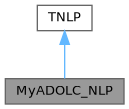
Inheritance diagram for MyADOLC_NLP:
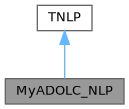
Collaboration diagram for MyADOLC_NLP:

Public Member Functions

 MyADOLC_NLP ()
 
virtual ~MyADOLC_NLP ()
 
Overloaded from TNLP
virtual bool get_nlp_info (Index &n, Index &m, Index &nnz_jac_g, Index &nnz_h_lag, IndexStyleEnum &index_style)
 
virtual bool get_bounds_info (Index n, Number *x_l, Number *x_u, Index m, Number *g_l, Number *g_u)
 
virtual bool get_starting_point (Index n, bool init_x, Number *x, bool init_z, Number *z_L, Number *z_U, Index m, bool init_lambda, Number *lambda)
 
template<class T >
bool eval_obj (Index n, const T *x, T &obj_value)
 
template<class T >
bool eval_constraints (Index n, const T *x, Index m, T *g)
 
virtual bool eval_f (Index n, const Number *x, bool new_x, Number &obj_value)
 
virtual bool eval_grad_f (Index n, const Number *x, bool new_x, Number *grad_f)
 
virtual bool eval_g (Index n, const Number *x, bool new_x, Index m, Number *g)
 
virtual bool eval_jac_g (Index n, const Number *x, bool new_x, Index m, Index nele_jac, Index *iRow, Index *jCol, Number *values)
 
virtual bool eval_h (Index n, const Number *x, bool new_x, Number obj_factor, Index m, const Number *lambda, bool new_lambda, Index nele_hess, Index *iRow, Index *jCol, Number *values)
 
Solution Methods
virtual void finalize_solution (SolverReturn status, Index n, const Number *x, const Number *z_L, const Number *z_U, Index m, const Number *g, const Number *lambda, Number obj_value, const IpoptData *ip_data, IpoptCalculatedQuantities *ip_cq)
 
virtual void generate_tapes (Index n, Index m)
 

Methods to block default compiler methods.

The compiler automatically generates the following three methods. Since the default compiler implementation is generally not what you want (for all but the most simple classes), we usually put the declarations of these methods in the private section and never implement them. This prevents the compiler from implementing an incorrect "default" behavior without us knowing. (See Scott Meyers book, "Effective C++")

double ** Jac
 
double * x_lam
 
double ** Hess
 
 MyADOLC_NLP (const MyADOLC_NLP &)
 
MyADOLC_NLPoperator= (const MyADOLC_NLP &)
 

Detailed Description

Definition at line 37 of file Adolc_debugtest.h.

Constructor & Destructor Documentation

◆ MyADOLC_NLP() [1/2]

default constructor

Definition at line 34 of file Adolc_debugtest.cpp.

35{}

◆ ~MyADOLC_NLP()

~MyADOLC_NLP ( )
virtual

default destructor

Definition at line 37 of file Adolc_debugtest.cpp.

37{}

◆ MyADOLC_NLP() [2/2]

MyADOLC_NLP ( const MyADOLC_NLP )
private

Member Function Documentation

◆ eval_constraints()

template<class T >
bool eval_constraints ( Index  n,
const T *  x,
Index  m,
T *  g 
)

Template to compute contraints

Definition at line 116 of file Adolc_debugtest.cpp.

117{
118 for (Index i=0; i<m; i++) {
119 g[i] = 3.*pow(x[i+1],3.) + 2.*x[i+2] - 5.
120 + sin(x[i+1]-x[i+2])*sin(x[i+1]+x[i+2]) + 4.*x[i+1]
121 - x[i]*exp(x[i]-x[i+1]) - 3.;
122 }
123
124 return true;
125}

Referenced by eval_g(), and generate_tapes().

Here is the caller graph for this function:

◆ eval_f()

bool eval_f ( Index  n,
const Number *  x,
bool  new_x,
Number &  obj_value 
)
virtual

Original method from Ipopt to return the objective value remains unchanged

Definition at line 136 of file Adolc_debugtest.cpp.

137{
138 eval_obj(n,x,obj_value);
139
140 return true;
141}
bool eval_obj(Index n, const T *x, T &obj_value)
Here is the call graph for this function:

◆ eval_g()

bool eval_g ( Index  n,
const Number *  x,
bool  new_x,
Index  m,
Number *  g 
)
virtual

Original method from Ipopt to return the constraint residuals remains unchanged

Definition at line 151 of file Adolc_debugtest.cpp.

152{
153
154 eval_constraints(n,x,m,g);
155
156 return true;
157}
bool eval_constraints(Index n, const T *x, Index m, T *g)
Here is the call graph for this function:

◆ eval_grad_f()

bool eval_grad_f ( Index  n,
const Number *  x,
bool  new_x,
Number *  grad_f 
)
virtual

Original method from Ipopt to return the gradient of the objective remains unchanged

Definition at line 143 of file Adolc_debugtest.cpp.

144{
145
146 gradient(tag_f,n,x,grad_f);
147
148 return true;
149}
#define tag_f

◆ eval_h()

bool eval_h ( Index  n,
const Number *  x,
bool  new_x,
Number  obj_factor,
Index  m,
const Number *  lambda,
bool  new_lambda,
Index  nele_hess,
Index *  iRow,
Index *  jCol,
Number *  values 
)
virtual

Original method from Ipopt to return: 1) The structure of the hessian of the lagrangian (if "values" is NULL) 2) The values of the hessian of the lagrangian (if "values" is not NULL) remains unchanged

Definition at line 190 of file Adolc_debugtest.cpp.

194{
195 if (values == NULL) {
196 // return the structure. This is a symmetric matrix, fill the lower left
197 // triangle only.
198
199 // the hessian for this problem is actually dense
200 Index idx=0;
201 for (Index row = 0; row < n; row++) {
202 for (Index col = 0; col <= row; col++) {
203 iRow[idx] = row;
204 jCol[idx] = col;
205 idx++;
206 }
207 }
208
209 assert(idx == nele_hess);
210 }
211 else {
212 // return the values. This is a symmetric matrix, fill the lower left
213 // triangle only
214
215 for(Index i = 0; i<n ; i++)
216 x_lam[i] = x[i];
217 for(Index i = 0; i<m ; i++)
218 x_lam[n+i] = lambda[i];
219 x_lam[n+m] = obj_factor;
220
221 hessian(tag_L,n+m+1,x_lam,Hess);
222
223 Index idx = 0;
224
225 for(Index i = 0; i<n ; i++)
226 {
227 for(Index j = 0; j<=i ; j++)
228 {
229 values[idx++] = Hess[i][j];
230 }
231 }
232 }
233
234 return true;
235}
#define tag_L

◆ eval_jac_g()

bool eval_jac_g ( Index  n,
const Number *  x,
bool  new_x,
Index  m,
Index  nele_jac,
Index *  iRow,
Index *  jCol,
Number *  values 
)
virtual

Original method from Ipopt to return: 1) The structure of the jacobian (if "values" is NULL) 2) The values of the jacobian (if "values" is not NULL) remains unchanged

Definition at line 159 of file Adolc_debugtest.cpp.

162{
163 if (values == NULL) {
164 // return the structure of the jacobian,
165 // assuming that the Jacobian is dense
166
167 Index idx = 0;
168 for(Index i=0; i<m; i++)
169 for(Index j=0; j<n; j++)
170 {
171 iRow[idx] = i;
172 jCol[idx++] = j;
173 }
174 }
175 else {
176 // return the values of the jacobian of the constraints
177
178 jacobian(tag_g,m,n,x,Jac);
179
180 Index idx = 0;
181 for(Index i=0; i<m; i++)
182 for(Index j=0; j<n; j++)
183 values[idx++] = Jac[i][j];
184
185 }
186
187 return true;
188}
#define tag_g

◆ eval_obj()

template<class T >
bool eval_obj ( Index  n,
const T *  x,
T &  obj_value 
)

Template to return the objective value

Definition at line 103 of file Adolc_debugtest.cpp.

104{
105 T a1, a2;
106 obj_value = 0.;
107 for (Index i=0; i<n-1; i++) {
108 a1 = x[i]*x[i]-x[i+1];
109 a2 = x[i] - 1.;
110 obj_value += 100.*a1*a1 + a2*a2;
111 }
112
113 return true;
114}

Referenced by eval_f(), and generate_tapes().
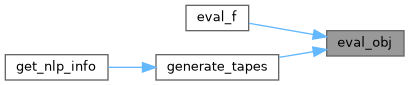
Here is the caller graph for this function:

◆ finalize_solution()

void finalize_solution ( SolverReturn  status,
Index  n,
const Number *  x,
const Number *  z_L,
const Number *  z_U,
Index  m,
const Number *  g,
const Number *  lambda,
Number  obj_value,
const IpoptData *  ip_data,
IpoptCalculatedQuantities *  ip_cq 
)
virtual

This method is called when the algorithm is complete so the TNLP can store/write the solution

Definition at line 237 of file Adolc_debugtest.cpp.

243{
244
245 printf("\n\nObjective value\n");
246 printf("f(x*) = %e\n", obj_value);
247
248// Memory deallocation for ADOL-C variables
249
250 delete[] x_lam;
251
252 for(Index i=0;i<m;i++)
253 delete[] Jac[i];
254 delete[] Jac;
255
256 for(Index i=0;i<n+m+1;i++)
257 delete[] Hess[i];
258 delete[] Hess;
259}

◆ generate_tapes()

void generate_tapes ( Index  n,
Index  m 
)
virtual

Method to generate the required tapes

Definition at line 264 of file Adolc_debugtest.cpp.

265{
266 Number *xp = new double[n];
267 Number *lamp = new double[m];
268 Number *zl = new double[m];
269 Number *zu = new double[m];
270
271 adouble *xa = new adouble[n];
272 adouble *g = new adouble[m];
273 adouble *lam = new adouble[m];
274 adouble sig;
275 adouble obj_value;
276
277 double dummy;
278
279 Jac = new double*[m];
280 for(Index i=0;i<m;i++)
281 Jac[i] = new double[n];
282
283 x_lam = new double[n+m+1];
284
285 Hess = new double*[n+m+1];
286 for(Index i=0;i<n+m+1;i++)
287 Hess[i] = new double[i+1];
288
289 get_starting_point(n, 1, xp, 0, zl, zu, m, 0, lamp);
290
291 trace_on(tag_f);
292
293 for(Index i=0;i<n;i++)
294 xa[i] <<= xp[i];
295
296 eval_obj(n,xa,obj_value);
297
298 obj_value >>= dummy;
299
300 trace_off();
301
302 trace_on(tag_g);
303
304 for(Index i=0;i<n;i++)
305 xa[i] <<= xp[i];
306
307 eval_constraints(n,xa,m,g);
308
309
310 for(Index i=0;i<m;i++)
311 g[i] >>= dummy;
312
313 trace_off();
314
315 trace_on(tag_L);
316
317 for(Index i=0;i<n;i++)
318 xa[i] <<= xp[i];
319 for(Index i=0;i<m;i++)
320 lam[i] <<= 1.0;
321 sig <<= 1.0;
322
323 eval_obj(n,xa,obj_value);
324
325 obj_value *= sig;
326 eval_constraints(n,xa,m,g);
327
328 for(Index i=0;i<m;i++)
329 obj_value += g[i]*lam[i];
330
331 obj_value >>= dummy;
332
333 trace_off();
334
335 delete[] xa;
336 delete[] xp;
337 delete[] g;
338 delete[] lam;
339 delete[] lamp;
340 delete[] zu;
341 delete[] zl;
342
343}
virtual bool get_starting_point(Index n, bool init_x, Number *x, bool init_z, Number *z_L, Number *z_U, Index m, bool init_lambda, Number *lambda)

Referenced by get_nlp_info().

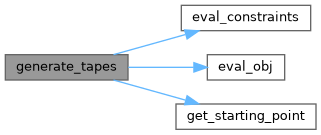
Here is the call graph for this function:
Here is the caller graph for this function:

◆ get_bounds_info()

bool get_bounds_info ( Index  n,
Number *  x_l,
Number *  x_u,
Index  m,
Number *  g_l,
Number *  g_u 
)
virtual

Method to return the bounds for my problem

Definition at line 61 of file Adolc_debugtest.cpp.

63{
64 // none of the variables have bounds
65 for (Index i=0; i<n; i++) {
66 x_l[i] = -1e20;
67 x_u[i] = 1e20;
68 }
69
70 // Set the bounds for the constraints
71 for (Index i=0; i<m; i++) {
72 g_l[i] = 0;
73 g_u[i] = 0;
74 }
75
76 return true;
77}

◆ get_nlp_info()

bool get_nlp_info ( Index &  n,
Index &  m,
Index &  nnz_jac_g,
Index &  nnz_h_lag,
IndexStyleEnum &  index_style 
)
virtual

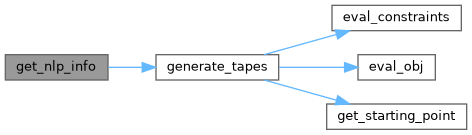
Method to return some info about the nlp

Definition at line 39 of file Adolc_debugtest.cpp.
41{
42 n = 20;
43
44 m = n-2;
45
46 // in this example the jacobian is dense. Hence, it contains n*m nonzeros
47 nnz_jac_g = n*m;
48
49 // the hessian is also dense and has n*n total nonzeros, but we
50 // only need the lower left corner (since it is symmetric)
51 nnz_h_lag = n*(n-1)/2+n;
52
53 generate_tapes(n, m);
54
55 // use the C style indexing (0-based)
56 index_style = C_STYLE;
57
58 return true;
59}
virtual void generate_tapes(Index n, Index m)
Here is the call graph for this function:

◆ get_starting_point()

bool get_starting_point ( Index  n,
bool  init_x,
Number *  x,
bool  init_z,
Number *  z_L,
Number *  z_U,
Index  m,
bool  init_lambda,
Number *  lambda 
)
virtual

Method to return the starting point for the algorithm

Definition at line 79 of file Adolc_debugtest.cpp.

83{
84 // Here, we assume we only have starting values for x, if you code
85 // your own NLP, you can provide starting values for the others if
86 // you wish.
87 assert(init_x == true);
88 assert(init_z == false);
89 assert(init_lambda == false);
90
91 // set the starting point
92 for (Index i=0; i<n/2; i++) {
93 x[2*i] = -1.2;
94 x[2*i+1] = 1.;
95 }
96 if (n != 2*(n/2)) {
97 x[n-1] = -1.2;
98 }
99
100 return true;
101}

Referenced by generate_tapes().

Here is the caller graph for this function:

◆ operator=()

MyADOLC_NLP & operator= ( const MyADOLC_NLP )
private

Member Data Documentation

◆ Hess

double** Hess
private

Definition at line 141 of file Adolc_debugtest.h.

Referenced by eval_h(), finalize_solution(), and generate_tapes().

◆ Jac

double** Jac
private

Definition at line 138 of file Adolc_debugtest.h.

Referenced by eval_jac_g(), finalize_solution(), and generate_tapes().

◆ x_lam

double* x_lam
private

Definition at line 140 of file Adolc_debugtest.h.

Referenced by eval_h(), finalize_solution(), and generate_tapes().


The documentation for this class was generated from the following files: